English
 Pусский
 Español
 عربي
عربي

Understanding Thermoforming Line ROI for New Factories
Article Overview: This article provides a practical framework for evaluating thermoforming line ROI when planning a new factory for plastic cups and containers. It covers the core drivers of return—throughput, material yield, energy consumption, and labor—and offers step-by-step guidance for building a simple ROI model. By the end, procurement teams and engineering managers will have a clear basis for comparing equipment options and making data-backed decisions.
What Factors Drive Thermoforming Line ROI?
Thermoforming line ROI is shaped by several interdependent variables. Understanding each factor separately helps you build a realistic financial model before committing capital. Below are the four primary drivers that directly affect payback period and long-term profitability.
- Throughput (cycles per minute): Higher cycle speeds increase output per shift, spreading fixed costs like rent and overhead over more units. However, faster machines often cost more upfront and require more robust material handling.
- Material yield (scrap rate): In thermoforming, scrap from trim web and rejected parts reduces effective output. A line with advanced servo control and optimized mold design can keep scrap below 5%, while older pneumatic lines may run at 10–15% scrap—dramatically affecting material cost per part.
- Energy consumption (kWh per part): Heating plastic sheets accounts for the largest energy expense. Efficient infrared heaters and preheating systems (like those in preheating systems) lower energy use, directly improving ROI in regions with high electricity prices.
- Labor cost (operators per line): Modern thermoforming machines with integrated stacking, cutting, and in-line scrap reclaim reduce manual handling. A line that needs one operator instead of two can save USD 30,000–50,000 annually, depending on local wages.
Example scenario: Consider a hypothetical new factory running two 8-hour shifts. A baseline line producing 30 cycles/min with 10% scrap and 2 operators might yield a simple payback of 18 months. Reducing scrap to 4% and automating stacking cuts payback to 14 months—a significant improvement in thermoforming machine ROI.
How to Calculate Thermoforming Line ROI for Your Facility?
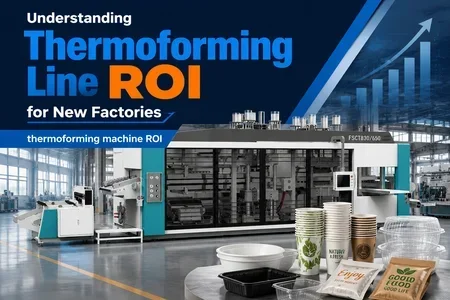
Building a clear ROI model requires input from both production targets and cost assumptions. Follow these steps to create a reusable spreadsheet for evaluating any thermoforming line ROI.
Step 1: Define Annual Output Requirements
Start with your target production volume in parts per year. For example, 50 million cups per year. Convert that to required cycles per minute using mold cavity count and available operating hours (including downtime). This sets the minimum speed your line must achieve.
Step 2: Map Out Capital and Installation Costs
Include the thermoforming machine, sheet extruder (if in-line), molds, material handling equipment, and auxiliary systems like crushers and stackers. Also budget for installation, wiring, air piping, and training. Total initial investment is the denominator in your ROI calculation.
Step 3: Estimate Annual Operating Costs
Sum material cost (sheet price minus scrap revenue), energy cost, labor (fully loaded), maintenance (1–3% of machine cost per year), and consumables (lubricants, filters). Subtract any savings from integrated in-line scrap reclaim. This gives your net annual operating expense.
Step 4: Compute Gross Margin and Payback Period
Set a selling price per part. Multiply by annual output to get revenue. Subtract operating costs for gross profit. Divide the total investment by annual gross profit to find simple payback (in years). A result under 2 years is typically attractive for new factories. Refine the model by incorporating financing costs and tax effects if needed.
Once your model is built, you can apply it to different equipment options. For a detailed walkthrough of ROI across common cup and container applications, visit our application center, which provides specific thermoforming line ROI data for various products.
Comparing ROI Across Different Thermoforming Configurations
Not all thermoforming lines are alike. The configuration you choose—standalone vs. in-line, single-station vs. multi-station—directly affects upfront cost and operating efficiency. The table below compares three common setups for a mid-volume cup factory.
Configuration Comparison
Option A: Standalone Thermoformer + Offline Sheet
Lower initial investment (around USD 200,000–350,000). Higher material cost due to purchased sheet and two-step heating. More labor for sheet handling and storage. Best for low-volume or multi-SKU facilities.
Option B: In-line Extruder + Thermoformer (Turnkey)
Higher initial investment (USD 500,000–800,000). Direct extrusion yields lower scrap and energy use. One operator can manage both extrusion and forming. Ideal for high-volume dedicated lines producing standard cups.
Option C: Multi-Station Rotary Thermoformer
Investment can exceed USD 1 million. Extremely high throughput (50+ cycles/min) with automated trimming and stacking. Lowest per-part cost but requires consistent demand and skilled maintenance. Best for factories running 24/7.
Buyer note: Evaluate your own scenarios. A standalone line might offer better thermoforming machine ROI if you plan to change products frequently, while an in-line configuration maximizes margin on long runs.
Key Considerations for Maximizing Thermoforming Line ROI
Beyond the initial model, several operational decisions can improve actual return. Below are actionable points to review during equipment evaluation.
- Automate where it counts: In-line cutting and stacking (e.g., on-line auto cutting and stacking machines) reduce manual labor and rework. Even modest automation can cut payback by 4–6 months.
- Integrate scrap reclaim: On-line crushers that feed trim directly back into the extruder lower net material cost. This is especially valuable when running expensive food-grade resins.
- Plan for preventive maintenance: Downtime kills ROI. Budget for spare parts and a maintenance schedule. A line with 95% uptime yields 11% more annual output than one at 85% uptime—often the difference between a 2-year and 3-year payback.
- Consider energy optimization: Preheaters and servo-driven drives can reduce kWh per part by 15–20%. In regions where industrial electricity costs USD 0.12/kWh, that translates to significant annual savings.
FAQ
How do I estimate scrap rate for a new thermoforming line?
Start with the supplier's scrap guarantee (typically 3–8% for modern servo-driven lines). Add a factor for setup waste (mold changes and startup) of 1–2% of annual production. In early planning, use 6% as a realistic baseline and adjust based on part complexity.
What is a typical payback period for a thermoforming line?
For a new factory producing standard cups at moderate volume (30–50 million parts/year), simple payback often ranges from 18 months to 3 years. Higher automation and lower scrap reduce this toward 12–18 months.
Should I buy a new thermoforming line or a used one to improve ROI?
New lines offer lower scrap rates, better energy efficiency, and higher uptime—all of which improve ROI if utilization is high. Used lines have lower upfront cost but may require more maintenance. Calculate total cost of ownership (TCO) over 5 years for a fair comparison.
How does mold quality affect thermoforming line ROI?
Molds directly influence cycle time, part consistency, and scrap. A well-designed, water-cooled mold can reduce cycle time by 10–20% and scrap by 2–3% compared to a basic mold. Investing 20% more in molds often yields a faster payback overall.
Conclusion
Evaluating thermoforming line ROI is a structured process that balances capital expenditure with operating efficiencies in throughput, material yield, energy, and labor. By building a simple financial model and comparing configurations against your production requirements, you can identify the equipment that delivers the strongest return. Keep the four core drivers in mind, automate intelligently, and use supplier data to validate assumptions. For further guidance, explore the application center to see how different container designs affect thermoforming line ROI in practice.