English
 Pусский
 Español
 عربي
عربي

Lids Trays Clamshells Thermoforming Comparison
Article Overview: This guide compares thermoforming machines designed for lids trays clamshells. We cover key selection criteria, performance trade-offs, and practical decision points to help buyers evaluate different solutions for lids trays clamshells thermoforming. Whether you are producing thin-walled lids, deep-draw trays, or hinged clamshells, understanding the machine specifications and their impact on production efficiency is critical.
Key Criteria for Lids Trays Clamshells Thermoforming
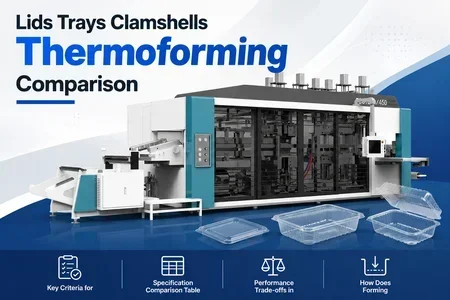
When evaluating a thermoforming machine for lids trays clamshells, buyers must consider forming depth, cut-in-place capability, stacking accuracy, and material handling. Each criterion directly affects part quality, cycle time, and overall line productivity. Below we compare two common specification ranges to illustrate trade-offs.
Option A: Standard thermoforming machine (forming depth up to 120 mm, cut-in-place, simple stacking). Suitable for shallow lids and small trays. Lower capital cost but limited depth flexibility.
Option B: Advanced thermoforming machine (forming depth up to 200 mm, servo-driven cut-in-place, intelligent stacking). Handles deep-draw trays and clamshells. Higher investment but greater versatility and reduced scrap.
Buyer note: If your product mix includes deep trays or hinged clamshells, Option B may reduce secondary operations. For high-volume shallow lids, Option A can be cost-effective.
Specification Comparison Table for Lids Trays Clamshells Thermoforming
The table below provides a side-by-side comparison of typical specifications between standard and advanced thermoforming machines for lids trays clamshells. Use this to quickly assess which configuration aligns with your product requirements.
| Parameter | Standard Machine (Option A) | Advanced Machine (Option B) |
|---|---|---|
| Maximum forming depth | 120 mm | 200 mm |
| Cut-in-place technology | Pneumatic, basic trim | Servo-driven, high precision |
| Stacking system | Conveyor, manual count | Robotic, automatic stacking with nested parts |
| Tooling changeover time | 30–60 minutes | Under 15 minutes (quick-change frames) |
| Material compatibility | PS, PP, PET (standard heating) | PS, PP, PET, PLA (modular heating zones) |
| Capital cost range | USD 80,000–150,000 | USD 180,000–350,000 |
Performance Trade-offs in Lids Trays Clamshells Thermoforming
Beyond basic specifications, performance trade-offs exist in heating uniformity, tooling changeover time, and material compatibility. The following comparison highlights considerations for production flexibility versus throughput.
Option A: Standard heater bank (quartz or ceramic) with fixed zones. Quicker initial tuning but less control for varied material types. Changeover requires manual adjustment of plugs and forms.
Option B: Modular heating with individual zone control (infrared or gas). Allows fine-tuning for different sheet thicknesses and materials (PP, PS, PET). Automated quick-change tooling reduces downtime between runs.
Buyer note: For operations with frequent product changes, Option B improves overall equipment effectiveness despite higher upfront cost.
How Does Forming Depth Affect Your Choice for Lids Trays Clamshells?
Forming depth determines the maximum part height, which is critical for tray and clamshell designs. Cut-in-place (CIP) eliminates secondary trimming, saving labor and improving dimensional accuracy. Machines with deeper forming depth often require larger platens and more robust clamping systems. Evaluate your current and future product range to decide the depth you need.
- Shallow parts (≤60 mm): Standard machines with simple trimming suffice.
- Deep parts (60–150 mm): Machines with servo-driven forming and CIP reduce waste.
- Very deep parts (>150 mm): Consider multi-station thermoforming machines that allow pre-stretching and vacuum assist. For more complex geometries, explore multi-station thermoforming machines that can handle deeper draws and integrated stacking.
What Stacking and Material Handling Options Work Best?
Efficient stacking and material handling reduce labor cost and prevent part damage. Key options include conveyor-based stacking, robotic pick-and-place, and automatic counting/stacking systems. The choice depends on output volume and part geometry.
- Low-volume: Manual stacking may be acceptable; invest in simple conveyors.
- Medium-volume: Semi-automatic stacking with pneumatic or servo-driven stackers.
- High-volume: Fully automated intelligent stacking robots that handle multiple lanes and nested stacking. For high-speed production of lids trays clamshells, an integrated lids trays clamshells thermoforming system with in-line stacking improves overall line efficiency.
FAQ
What is the typical forming depth range for lids trays clamshells thermoforming?
Forming depth typically ranges from 20 mm to 200 mm depending on the machine design. Shallow lids may only need 20–40 mm, while deep trays or clamshells often require 100–150 mm. Always verify the maximum forming depth of the thermoforming machine for lids trays clamshells against your product specifications.
How does cut-in-place technology improve production?
Cut-in-place eliminates the downstream trimming step by cutting the part from the sheet while it is still in the forming station. This improves dimensional consistency and reduces scrap. It is especially beneficial for clamshells and trays where edge quality matters.
Can one machine handle both lids and deep trays?
Yes, many modern thermoforming machines for lids trays clamshells offer adjustable forming depth and interchangeable tooling. However, high-volume production of shallow lids may benefit from a dedicated machine to maximize throughput.
Conclusion
Selecting the right thermoforming machine for lids trays clamshells requires balancing forming depth, cut-in-place capability, stacking automation, and changeover flexibility. Use the comparison table and blocks above to weigh standard versus advanced options against your production requirements. For a complete system tailored to your product mix, always consider future scalability. Evaluate sample parts and request a trial run with your materials before making a final decision.