English
 Pусский
 Español
 عربي
عربي

Thermoforming Machine Quotation: Procurement Checklist
Article Overview: This article provides a comprehensive procurement checklist for obtaining a reliable thermoforming machine quotation. It covers essential quote requirements, supplier evaluation criteria, risk mitigation strategies, and practical steps to prepare your inquiry. Designed for buyers and procurement decision-makers, the guide ensures you gather the right information to compare quotes effectively and make a confident investment.
What Should You Include in Your Thermoforming Machine Quote Requirements?
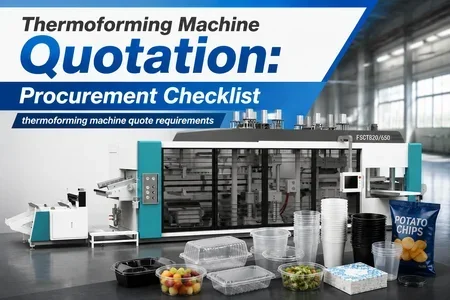
When requesting a thermoforming machine quotation, providing complete and accurate specifications is critical. Incomplete requirements lead to inaccurate pricing, longer lead times, and potential operational mismatches. Below are the key elements every buyer should include.
Product Drawings and Specifications
Submit detailed 2D or 3D drawings of the products you intend to form. Include critical dimensions, tolerances, material thickness, and any special features such as undercuts or embossing. Clear drawings enable suppliers to recommend the correct mold design and machine configuration.
Material Type and Properties
Specify the plastic material(s) you plan to use (e.g., PP, PS, PET, PLA). Provide information on material grade, melt flow index, and any additives. Different materials affect heating times, forming pressures, and cooling requirements, which directly impact the machine design and quotation.
Annual Volume and Production Rate
State your target annual volume and desired cycles per minute or output per hour. Volume determines whether a single-station, multi-station, or roll-fed thermoforming machine is most cost-effective. For high volumes, a multi-station or inline system may offer the lowest per-unit cost.
Sheet Width and Thickness Range
Indicate the sheet or roll width range your process requires. Machine width, heating zone layout, and trim capability depend on this parameter. If you plan to run multiple cavities per cycle, sheet width directly affects tooling layout and efficiency.
Downstream Equipment Needs
Identify any post-forming requirements such as trimming, stacking, counting, or packing. A complete thermoforming machine quotation should include compatible downstream solutions. For instance, if you produce containers that require rim curling, mention that in your request.
Utilities and Facility Constraints
Provide information on available electrical power (voltage, phase, frequency), compressed air capacity, cooling water supply, and floor space dimensions. These constraints help suppliers propose a system that fits your existing infrastructure without costly upgrades.
Step 1: Gather Your Core Specifications
Collect product drawings, material data sheets, and volume projections. Ensure all documents are in a standard format (PDF or CAD). This step forms the foundation of your thermoforming machine quote requirements.
How to Evaluate a Thermoforming Machine Quotation
Once you receive multiple quotations, a structured evaluation is essential. A lower price may hide higher operating costs or inadequate support. Use the following criteria to compare offers objectively.
- Technical Fit: Does the proposed machine meet your sheet width, cycle time, and material handling needs? Check heating system type (ceramic, quartz, gas) and mold compatibility.
- Total Cost of Ownership: Include energy consumption, tooling costs, maintenance intervals, and spare parts availability. Ask for lifetime cost estimates.
- Lead Time and Installation: Confirm delivery timeline, installation support, and training included in the thermoforming machine quotation. Delays can disrupt production schedules.
- After-Sales Support: Evaluate warranty terms, remote troubleshooting, local service availability, and response times. Reliable support reduces downtime risk.
For example, a buyer producing disposable cups should compare a thermoforming machine quotation for plastic cup production versus a general-purpose machine. The specialized quotation may include integrated trim and stack systems that lower overall labor costs.
Risk Controls and Common Pitfalls
Procurement mistakes can lead to costly rework. Avoid these common errors when reviewing a thermoforming machine quotation.
Under-Specifying Requirements
Omitting details like material variance or multi-cavity tooling can result in a machine that cannot achieve your desired output. Always list worst-case scenarios (e.g., maximum thickness, tightest tolerance).
Ignoring Auxiliary Equipment
Downstream equipment such as stackers, leak testers, or conveyors often represent a significant portion of the total line cost. Request a quotation that includes all necessary peripherals, or get separate quotes for them. Check thermoforming machine quotation solutions for cup production that bundle essential add-ons.
Overlooking Energy Efficiency
Heating and cooling account for a large share of operating expenses. Compare specific energy consumption (kWh per kg of material) across quotations. Machines with servo-driven systems or advanced insulation can reduce costs significantly over time.
- Define your production envelope clearly.
- Request references from the supplier for similar applications.
- Visit an existing installation or request a factory test.
- Include contract clauses for performance guarantees.
Step 2: Evaluate Supplier Capabilities
After receiving quotations, shortlist suppliers based on technical fit. Request a sample run with your material and molds. Verify that the proposed machine can consistently meet your cycle time and quality standards. This step reduces the risk of underperformance after purchase.
How to Prepare Your Inquiry for Maximum Response Quality
To receive accurate and comparable quotations, structure your request for quotation (RFQ) carefully.
- Create a Specification Sheet: List all critical parameters in a standardized format. Include tables for product dimensions, material properties, and utility requirements.
- Define Acceptance Criteria: Specify acceptable cycle time variation, scrap rate, and changeover time. Clear criteria help suppliers propose the most suitable design.
- Request a Breakdown: Ask for separate line items for the base machine, tooling, installation, training, and warranty. This transparency simplifies comparison.
- Set a Timeline: State your decision deadline and expected delivery date. Suppliers can prioritize your project if they know the schedule.
By providing a complete RFQ, you enable suppliers to generate a precise thermoforming machine quotation that reflects your real needs. This approach also builds trust and reduces back-and-forth clarifications.
Frequently Asked Questions
What is the most important piece of information I should include in my thermoforming machine quote requirements?
The most critical element is your product's detailed geometry and material specification. Without accurate drawings and material data, suppliers cannot determine mold complexity, heating requirements, or cycle time. This directly affects the accuracy of the quotation and the machine's suitability.
How many quotes should I obtain before making a decision?
At least three to five quotations from reputable suppliers. This allows you to benchmark pricing, technical approaches, and service terms. However, ensure all suppliers receive the same set of requirements to enable fair comparison.
Can I negotiate a thermoforming machine quotation after receiving it?
Yes, negotiation is common. Focus on total cost of ownership rather than just the purchase price. You can discuss extended warranty, free training, or discounts on spare parts. Be transparent about competitive offers to leverage better terms.
What should I do if my production requirements change after receiving a quotation?
Inform the supplier immediately. Changes in volume, material, or product design may require a revised thermoforming machine quotation. It is better to request an updated quote than to risk purchasing a machine that does not meet new requirements.
How long does it typically take to receive a detailed thermoforming machine quotation?
Depending on complexity, expect one to four weeks. Simple machines with standard specifications can be quoted within a week, while custom systems with multiple downstream components may take longer. Plan your procurement timeline accordingly.
Conclusion
Obtaining a reliable thermoforming machine quotation is a structured process that requires clear communication of your production needs, careful evaluation of supplier proposals, and proactive risk management. By following the procurement checklist outlined in this article—defining specifications, using evaluation criteria, avoiding common pitfalls, and preparing a thorough RFQ—you can select a machine that delivers optimal performance, cost efficiency, and long-term value. For further guidance on specific applications, such as cup manufacturing, explore dedicated thermoforming machine quotation solutions that address industry-specific challenges.