English
 Pусский
 Español
 عربي
عربي

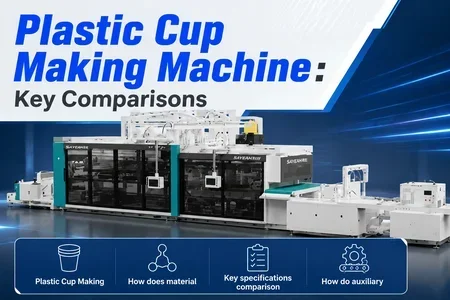
Plastic Cup Making Machine: Key Comparisons
Article Overview: This guide provides a neutral comparison of Plastic Cup Making Machine - Sayeah Machinery and similar systems, focusing on throughput, dimensional accuracy, material compatibility, and auxiliary integration. It helps procurement teams and production engineers weigh trade-offs and select the best solution for their specific cup portfolio.
Plastic Cup Making Machine - Sayeah Machinery: Speed vs. Precision
When evaluating a Plastic Cup Making Machine - Sayeah Machinery or any high-speed thermoformer, the primary trade-off is between output volume and part quality. Rotary multi-station machines can exceed 30,000 cups per hour but may sacrifice wall thickness uniformity. Shuttle or single-station designs offer tighter tolerances (±0.05 mm) but lower peak output (15,000–20,000 cups per hour). The choice depends on your median cup size and wall thickness requirements. For thin-wall cups (0.3–0.5 mm), precision-first configurations reduce scrap and rework.
Option A: High-Throughput Rotary
- Peak output: 30,000+ cups/hr
- Typical tolerance: ±0.10 mm
- Best for standard drinking cups (200–500 ml)
- Requires precise synchronization of heating, forming, punching
Option B: Precision Shuttle/Station
- Peak output: 15,000–20,000 cups/hr
- Typical tolerance: ±0.05 mm
- Handles heavier gauge or multi-layer materials
- Lower scrap rate during startup
Buyer note: Measure your median cup volume and wall thickness. For commodity cups, Option A minimizes cost per unit; for custom or barrier cups, Option B reduces waste and ensures consistency.
How does material compatibility affect machine selection?
The Plastic Cup Making Machine - Sayeah Machinery series supports PP, PS, PET, and PLA, but real-world capability depends on the extruder and sheet type. Mono-layer extrusion lines (e.g., a plastic sheet extruder) are adequate for single-material cups. Multi-layer co-extrusion enables barrier layers for dairy or hot-fill applications, requiring additional screw design and adhesive tie layers. When specifying, consider your current and future product line: if you plan to produce both cups and lids, the machine must handle the same sheet width and gauge for both. Multi-layer materials often narrow the thickness range.
Option A: Single-Layer Operation
- Lower material cost
- Simpler recycling
- Limited barrier properties
- Best for dry goods or cold cups
Option B: Multi-Layer Co-Extrusion
- Oxygen and moisture barrier
- Extended shelf life for dairy/juices
- Requires compatible adhesive tie layers
- Narrower sheet thickness range
Buyer note: If your primary application requires barrier properties, verify that the Plastic Cup Making Machine system can be integrated with a co-extrusion line. Otherwise, single-layer is more economical.
Key specifications comparison table
| Parameter | High-Throughput Rotary | Precision Shuttle/Station |
|---|---|---|
| Max output (cups/hr) | 30,000+ | 15,000–20,000 |
| Typical tolerance (±mm) | 0.10 | 0.05 |
| Material thickness range (mm) | 0.3–1.0 | 0.3–1.5 |
| Multi-layer capability | Limited (requires modification) | Yes, with co-extruder |
| Mold change time (min) | 30–45 | 20–30 |
| Typical scrap rate | 3%–8% | 2%–5% |
How do auxiliary equipment integration choices affect total line efficiency?
A complete cup production line includes punching, printing, rim curling, counting, and packing. The decision to integrate inline or offline impacts footprint, labor cost, and changeover time.
Step 1: List required post-forming operations
Common steps: cup stacking, side punching (for stacked cups), offset printing, rim curling, leak testing, and packaging. Each adds a potential bottleneck.
Step 2: Evaluate inline vs. offline setup
Inline: All stations synchronize with the thermoformer, reducing handling and labor but increasing main line complexity. Offline: Separate punching, printing, and packing machines (e.g., hydraulic punch, automatic counting/packing unit) provide flexibility for different products simultaneously but require more floor space and operators.
Consider these auxiliary equipment categories when specifying:
- Side punching machine: servo-driven, low noise, for blister containers.
- Six-color curved surface printer: for accurate printing on cup walls.
- Rim curling machine: creates rolled rims for drinking cups.
- Automatic cup counting and packing machine: reduces manual counting errors.
Operating costs and maintenance: what to watch for
Total cost of ownership includes energy consumption, mold life, spare parts availability, and technical support. Most modern Plastic Cup Making Machine - Sayeah Machinery use servo-driven indexing and PLC control, reducing electrical use compared to hydraulic presses. However, heating elements (quartz or ceramic) wear out and need periodic replacement. Maintenance checkpoints:
- Heater bank condition: measure temperature deviation across zones; replace if >5°C variation.
- Mold alignment: check guide pins each quarter.
- Punching die sharpness: dull dies create burrs; re-sharpen after 500,000 cycles.
- Vacuum pump efficiency: clean filters monthly.
FAQ
What should buyers evaluate first about Plastic Cup Making Machine - Sayeah Machinery?
Start with fit, evidence-backed requirements, and supplier proof relevant to Plastic Cup Making Machine - Sayeah Machinery before shortlisting vendors.
How can teams reduce procurement risk for Plastic Cup Making Machine - Sayeah Machinery?
Use structured comparison, validate specifications early, and review implementation or quality checkpoints with documented evidence.
Related articles
- Plastic Cup Making Machine - Sayeah Machinery Guide
- Pressure Forming Vs Vacuum Forming Procurement Checklist
- How Does Thermoforming Work? Step-by-Step Guide
Conclusion
Selecting a Plastic Cup Making Machine - Sayeah Machinery or any comparable system requires balancing speed, precision, material compatibility, and auxiliary integration. Define your product mix first, then evaluate throughput and tolerance needs. Use the comparisons and specification table above to create a weighted scorecard for your evaluation committee. A thorough site visit and material trial with your own resin is recommended before finalizing specifications. For further details, explore the Plastic Cup Making Machine product page.