English
 Pусский
 Español
 عربي
عربي

How Does Thermoforming Work? Step-by-Step Guide
Article Overview: This article explains how does thermoforming work across its core process stages, compares the two dominant machine configurations—cut-sheet and roll-fed—and provides a decision framework to help procurement teams, technical architects, and CTOs select the right thermoforming process for their plastic forming needs. Emphasis is placed on trade-offs, specification differences, and buyer-side evaluation criteria.
How Does Thermoforming Work? A Step-by-Step Breakdown
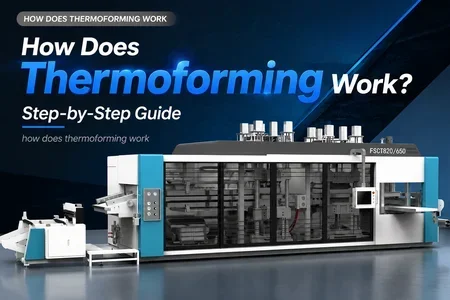
The thermoforming process transforms a flat thermoplastic sheet into a three-dimensional part using heat, pressure, and a mold. While variations exist, the fundamental steps are consistent across most industrial applications. Understanding each phase helps buyers assess machine capabilities and process fit.
Step 1: Sheet Heating
A plastic sheet (e.g., PP, PS, PET) is clamped and moved into a heating station. Radiant heaters—typically ceramic, quartz, or gas-fired—raise the sheet to its forming temperature. The heating profile must be uniform to avoid thin spots or sagging. Key parameters: heater type, distance, and heating time.
Step 2: Forming
The softened sheet is advanced over a mold. Vacuum pressure (negative) or compressed air (positive) forces the sheet against the mold surface. Some processes combine both. Mold temperature, material distribution, and forming speed dictate part quality.
Step 3: Cooling
The formed part is cooled to solidify its shape. Cooling can be passive (ambient air) or active (water channels, forced air, mist). Cycle time is often dominated by cooling; efficient cooling systems reduce overall production time.
Step 4: Trimming
The formed part is separated from the surrounding web (skeleton). Trimming methods include steel-rule die cutting, punch-and-die, or robotic routing. The choice affects scrap rate, edge finish, and line speed.
Step 5: Stacking & Collection
Finished parts are counted, stacked, and prepared for packaging or downstream operations. Integrated stacking robots or conveyor systems improve automation and reduce labor.
Comparing Thermoforming Process Configurations: Cut-Sheet vs. Roll-Fed
One of the first decisions in selecting a thermoforming process for cup production is whether to use a cut-sheet or roll-fed system. Each configuration has distinct advantages depending on part size, volume, and material handling preferences.
Cut-Sheet Thermoforming
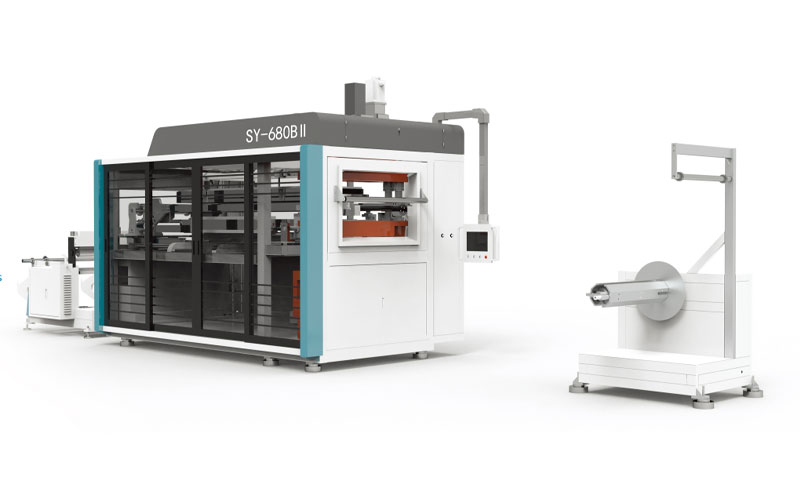
Option A: Sheets are precut to a fixed size and fed individually into the machine. This method is common for large parts (e.g., bathtubs, automotive panels) or small runs because tooling is simpler and sheet changeovers are fast. Material waste can be higher due to edge trim, but scrap is often single-material and recyclable.
Buyer note: Best for low-to-medium production volumes, large parts, or when frequent material changes are required. Process integration is straightforward but automation for sheet loading adds complexity.
Roll-Fed Thermoforming
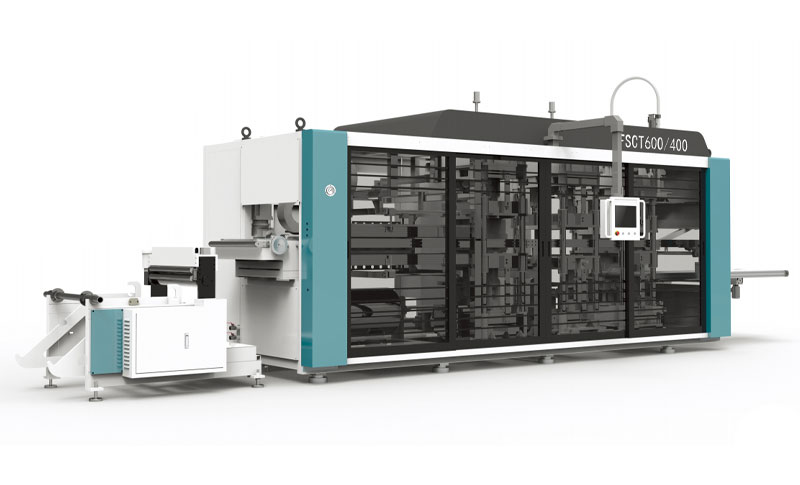
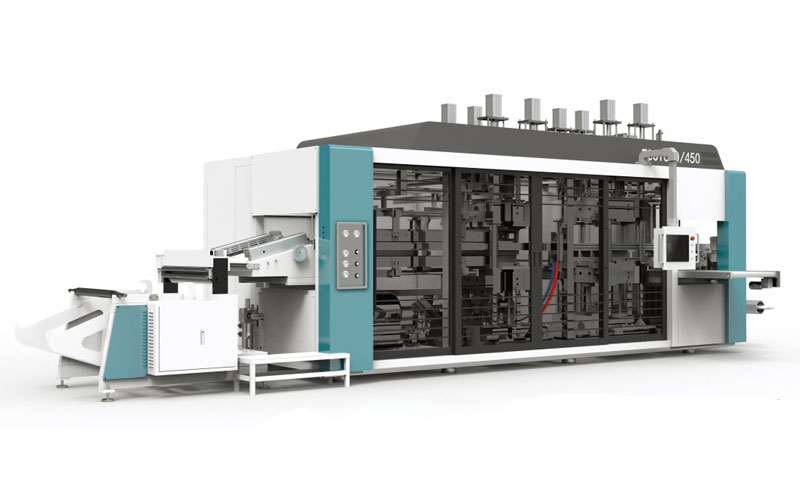
Option B: Continuous roll stock is fed through the machine in-line. Roll-fed systems dominate high-volume packaging (cups, lids, trays). They minimize handling, reduce labor, and maximize material yield through nested mold layouts and in-line trimming.
Buyer note: Ideal for high volumes (millions of parts per year) and small-to-medium sized parts. Requires a dedicated material unwind and often a downstream winder or stacker. Tooling costs per cavity are lower than cut-sheet for high cavity counts.
When evaluating which configuration suits your operation, consider the following criteria:
- Annual part volume and forecast growth
- Part dimensions and complexity
- Material type and width preferences
- Floor space and line layout
- Scrap management and recycling capability
Single-Station vs. Multi-Station Thermoforming: Which Fits Your Production?
Beyond the sheet format, the number of stations in a multi-station thermoforming machine affects throughput, flexibility, and capital cost. Single-station machines perform all steps in one location, while multi-station machines distribute steps across separate indexed stations.
Single-Station
Option A: All process steps happen sequentially at one forming station. Lower initial investment and smaller footprint. Suitable for prototyping, low-volume production, or very large parts. Cycle time is longer because heating, forming, and cooling share the same station.
Multi-Station
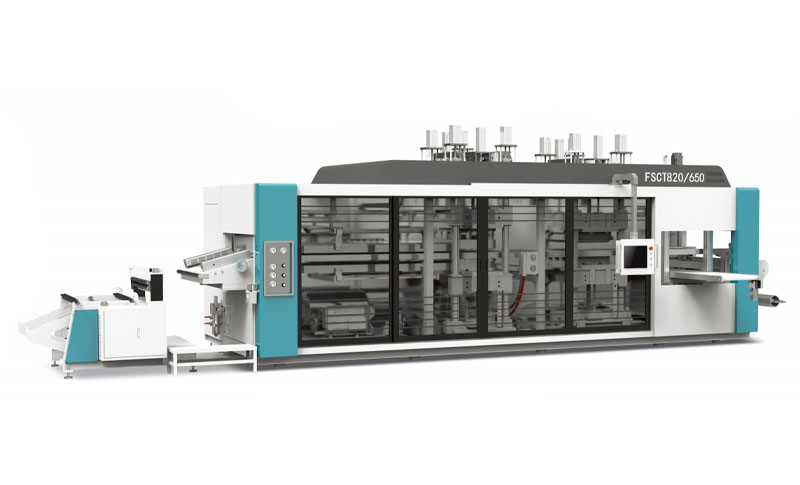
Option B: Stations are arranged sequentially (heating, forming, cooling, trimming) with the sheet indexed between them. Each station can be optimized independently, enabling higher throughput and consistent quality. Modular design allows future expansion. Higher capital cost and larger footprint.
Buyer note: For high-volume production (e.g., disposable cups, food containers), multi-station systems offer better per-part cost. Evaluate return on investment based on expected run sizes and changeover frequency.
What Factors Should You Evaluate When Choosing a Thermoforming Process?
Selecting the right thermoforming process requires a systematic evaluation of technical and business parameters. Below are the key decision checkpoints:
- Material compatibility: Can the process handle your required plastic (PP, PS, PET, PLA)? Each material has specific forming temperature windows and shrinkage rates.
- Part geometry: Deep-draw ratios, undercuts, and required wall thickness uniformity influence mold type (female vs. male) and forming technique (vacuum, pressure, twin-sheet).
- Cycle time target: Cooling and heating efficiency directly affect output. Compare available heating power and cooling method across machine candidates.
- Automation level: Robot in-mold labeling, automatic trimming, and stacking integration reduce labor but increase complexity. Match automation to your labor cost and quality consistency goals.
- Scrap management: In-line grinding and recycling can reclaim up to 90% of skeleton waste. Evaluate whether the machine supports closed-loop scrap re-feed.
Key Specification Comparison: Cut-Sheet vs. Roll-Fed (Typical Values)
| Criterion | Cut-Sheet | Roll-Fed |
|---|---|---|
| Typical sheet thickness | 1–6 mm | 0.2–2 mm |
| Maximum part size | Up to 3 m² | Generally < 0.5 m² |
| Annual volume suitability | < 500,000 parts | > 500,000 parts |
| Tooling cost per cavity | Moderate | Lower (high cavity count) |
| Material yield | 75–85% | 85–95% (nested molds) |
FAQ
What industries use thermoforming?
Thermoforming is widely used in food packaging (cups, trays, clamshells), medical device trays, automotive interior panels, consumer goods, and industrial components. The process is valued for its relatively low tooling cost and speed to market compared to injection molding.
How does thermoforming compare to injection molding?
Thermoforming generally has lower mold costs and faster setup for short-to-medium runs, but injection molding offers tighter tolerances and more complex geometries. For high-volume thin-wall parts like disposable cups, thermoforming can be more cost-effective due to simpler molds and the ability to run multi-cavity tooling.
Can thermoforming handle recycled materials?
Yes, many thermoforming lines can process post-industrial recycled (PIR) or post-consumer recycled (PCR) materials. However, melt flow index and contamination levels must be controlled. In-line scrap grinders can feed skeleton waste directly back into the sheet extruder for closed-loop recycling.
What is the typical cycle time for a thermoforming machine?
Cycle times vary widely by part geometry, thickness, and machine type. Thin-wall cup production can achieve 20–30 cycles per minute using multi-station roll-fed machines, while large thick-gauge parts may take 60–120 seconds per cycle on a single-station press. Validate cycle times against your target output.
Conclusion: Selecting the Right Thermoforming Process
Understanding how does thermoforming work is only the first step. The technical decision between cut-sheet and roll-fed, or between single-station and multi-station, depends on your production volume, part specifications, and automation requirements. By mapping the process steps to your operational constraints—material type, throughput targets, scrap strategy, and capital budget—you can identify the thermoforming process solution that aligns with your business goals. Evaluate each candidate machine against the criteria outlined above, and request a machine trial with your specific material to confirm performance before making a procurement decision.