English
 Pусский
 Español
 عربي
عربي

Pressure Forming Vs Vacuum Forming Procurement Checklist
Article Overview: This article provides a structured procurement checklist for buyers evaluating pressure forming vs vacuum forming. It covers technical differences, cost trade-offs, material suitability, quality criteria, and supplier evaluation steps. Decision-makers will find actionable insights to select the right thermoforming method for their production needs, with a focus on the key comparison of pressure vs vacuum thermoforming.
What Is the Core Difference Between Pressure Forming and Vacuum Forming?
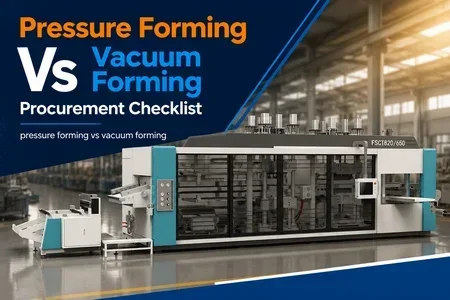
Understanding the fundamental difference between pressure forming and vacuum forming is essential for procurement. In vacuum forming, a heated plastic sheet is drawn onto a mold by vacuum suction, creating parts with moderate detail and uniform wall thickness. Pressure forming, by contrast, uses compressed air to push the sheet into the mold, enabling sharper details, deeper draws, and a wider range of surface finishes. This pressure vs vacuum thermoforming distinction directly impacts tooling complexity, cycle time, and part cost.
For buyers, the choice often hinges on part geometry and aesthetic requirements. Pressure forming vs vacuum forming becomes a decision between higher precision with slightly higher tooling cost versus simpler, lower-cost tooling for less demanding parts. When sourcing a pressure vs vacuum thermoforming solution, consider the specific features of your product—such as undercuts, textured surfaces, or tight tolerances—to determine which process meets your quality targets without over-specifying.
How to Evaluate Tooling Cost and Production Volume?
Tooling cost is a primary consideration in pressure forming vs vacuum forming procurement. Vacuum forming typically uses aluminum or composite molds that are less expensive to fabricate. Pressure forming molds often require steel or reinforced aluminum to withstand the higher forces, leading to an initial investment that can be 20–50% more than vacuum forming tooling.
Step 1: Determine annual production volume
Low-volume runs (under 10,000 parts per year) may favor vacuum forming due to lower tooling amortization. High-volume runs (over 50,000 parts) often justify pressure forming tooling because per-part cost decreases with faster cycles and reduced scrap.
Step 2: Compare per-part cost estimates
Request quotes from suppliers for both processes using your part design. Include material, tooling, setup, and finishing costs. Pressure forming may offer lower reject rates for complex parts, offsetting higher tooling costs.
Procurement teams should also factor in the cost of secondary operations. Pressure forming often eliminates the need for painting or additional texturing, whereas vacuum-formed parts may require post-processing to meet cosmetic standards. When evaluating pressure forming vs vacuum forming, always request a total cost breakdown including tooling amortization over your projected volume.
Material Selection and Part Complexity
The choice of plastic material interacts closely with pressure forming vs vacuum forming. Both processes work with thermoplastics such as ABS, polycarbonate, polyethylene, and PETG. However, pressure forming can handle thicker sheets (up to 6 mm) and materials with higher melt strength, enabling larger, more rigid parts. Vacuum forming typically processes sheets up to 3 mm thickness.
- Materials for vacuum forming: softer grades, easier to form, suitable for thin-wall packaging, trays, and simple enclosures.
- Materials for pressure forming: high-impact grades, flame-retardant formulations, and glossy ABS for automotive interior panels and medical housings.
- Part complexity considerations: pressure forming supports sharp corners, molded-in textures, and tight dimensional tolerances (±0.25 mm). Vacuum forming is limited to gentle radii and looser tolerances (±0.5 mm).
For buyers comparing pressure vs vacuum thermoforming, a part complexity audit is recommended. Evaluate draft angles, draw depth, feature detail, and surface finish requirements. If your part requires a matte finish, snap-fit features, or critical fit to other components, pressure forming is likely the better choice.
Procurement Checkpoints: Quality and Supplier Capability
When sourcing a pressure forming vs vacuum forming supplier, use these checkpoints to minimize risk:
- Experience with your industry: Ask for case studies in your sector (automotive, packaging, medical, consumer goods).
- In-house tooling: Suppliers with CNC machining and mold-making capabilities can reduce lead times and improve quality control.
- Quality certifications: ISO 9001, IATF 16949 for automotive, or FDA registration for food contact are mandatory for many buyers.
- Process capability data: Request Cp/Cpk values for critical dimensions. This is especially important for pressure formed parts with tight tolerances.
- Secondary services: Trimming, assembly, and surface finishing capabilities reduce supply chain complexity.
Another critical checkpoint is the supplier's understanding of pressure forming vs vacuum forming trade-offs. A supplier that can advise on material selection, draft angle design, and cost reduction opportunities adds significant value. When visiting a supplier's facility, ask to see examples of similar parts made using both processes to judge the outcome differences firsthand.
FAQ
What should buyers understand first about pressure forming vs vacuum forming?
Buyers should start by defining the part’s functional and cosmetic requirements. Pressure forming is ideal when high detail, tight tolerances, or a high-end appearance are needed. Vacuum forming suits simpler, cost-sensitive applications where finish is less critical. The first step is always to create a clear requirement specification that includes dimensions, material, volume, and budget.
How can teams reduce selection risk between pressure forming and vacuum forming?
Use a structured comparison process: request prototype samples from at least two suppliers using both methods if feasible. Evaluate cycle time, scrap rate, and cosmetic quality. Also review the supplier’s experience with your specific material—some materials behave differently under pressure vs vacuum. A thorough supplier audit can prevent costly redesign later.
What are the typical lead times for pressure forming vs vacuum forming tooling?
Vacuum forming tooling can often be manufactured in 2–4 weeks, while pressure forming tooling may require 4–8 weeks due to higher precision and material hardness. Plan your procurement timeline accordingly, and discuss rush options with suppliers.
Can pressure formed parts replace vacuum formed parts without redesign?
Not directly. Pressure forming allows sharper corners, deeper draws, and features that vacuum forming cannot achieve. However, converting a vacuum-formed part to pressure forming may require adding texture or draft adjustments to optimize material flow. Always involve your supplier in a feasibility review before switching processes.
Conclusion
Choosing between pressure forming vs vacuum forming is a strategic procurement decision that affects part quality, cost, and time to market. By focusing on the key differences—tooling cost, material compatibility, part complexity, and supplier capability—buyers can select the process that aligns with their production goals. The checklist provided here serves as a practical guide for RFQs, supplier evaluations, and contract negotiations. For a deeper dive into production systems that support both methods, explore the pressure vs vacuum thermoforming system and related technologies on the site. With careful evaluation, your team can secure a reliable partner and achieve optimal part performance.