English
 Pусский
 Español
 عربي
عربي

Choose Your Food Packaging Thermoforming Machine
Article Overview: This solution comparison guide helps procurement teams and technical architects evaluate food packaging thermoforming machines based on critical criteria such as material compatibility, output rate, energy efficiency, and regulatory compliance. We compare roll-fed versus sheet-fed systems and inline versus shuttle architectures with a spec table and decision guidance for food container thermoforming machine applications.
How to Evaluate a Food Packaging Thermoforming Machine for Your Line
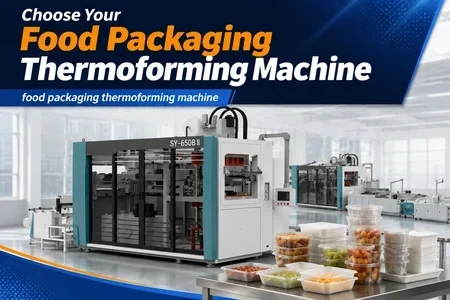
When assessing a machine for your production environment, focus on parameters that directly affect output quality and operational cost. Below is a structured evaluation process.
Step 1: Define Your Packaging Format and Material
Identify the exact container dimensions, wall thickness, and required material grade. For example, hot-fill applications demand PP or crystallized PET, while cold-fill can use amorphous PET. This decision narrows the machine’s heater configuration and mold compatibility.
Step 2: Determine Target Throughput and Cycle Time
Estimate peak production volume in containers per hour. A typical food container thermoforming machine cycles between 15–30 strokes per minute, with each stroke yielding multiple cavities. Validate the machine’s forming area and cavity count against your throughput target.
Step 3: Assess Regulatory and Hygiene Requirements
Food-grade packaging requires machines that avoid contamination and meet FDA/EU directives. Check that the forming station uses food-safe lubricants and that the heating zone has proper ventilation. Certifications such as CE may be mandatory for export markets.
Beyond these steps, compile a checklist of operational factors:
- Energy consumption per thousand cycles (kWh)
- Changeover time between product runs
- Availability of spare parts and local service
- Automation level (manual vs. robotic stacking)
- Floor space and utility connections
Step 4: Compare Total Cost of Ownership (TCO)
Include initial purchase price, installation, tooling, energy, and maintenance over a five-year horizon. A lower-priced machine may cost more in downtime and scrap. Request quotes from at least two suppliers and factor in the value of integrated features like in-line trimming and scrap regrinding.
Roll-Fed vs. Sheet-Fed: Which Food Packaging Thermoforming Machine Suits Your Production?
The choice between a roll-fed and a sheet-fed food packaging thermoforming machine significantly affects production continuity and material yield. Below is a spec comparison table for key parameters.
| Parameter | Roll-Fed | Sheet-Fed |
|---|---|---|
| Forming area (max) | 1200 × 800 mm | 800 × 600 mm |
| Max cycle speed | 30 cycles/min | 20 cycles/min |
| Material thickness range | 0.15 – 1.5 mm | 0.3 – 2.0 mm |
| Typical scrap rate | 2 – 5% | 5 – 10% |
| Relative investment level | Higher ($$$) | Lower ($$) |
Material Handling & Waste
Option A: Roll-Fed – Continuous sheet from a roll; minimal scrap between parts but requires a separate unwind stand. Ideal for high-volume, single-product runs.
Option B: Sheet-Fed – Pre-cut sheets loaded manually or by feeder; more flexibility for short runs and multi-color/multi-layer materials, but generates more edge scrap.
Buyer note: If your product mix changes frequently (e.g., different sizes each shift), sheet-fed can reduce tooling changeover overhead. For long runs of one design, roll-fed yields lower material waste.
Throughput & Automation
Option A: Roll-Fed – Typically operates at higher speeds (up to 30 cycles/min) due to continuous material flow. Often paired with automated stacking for food container thermoforming machine lines.
Option B: Sheet-Fed – Lower cycle speeds (10–20 cycles/min) because of sheet indexing time. However, sheet-fed machines can handle thicker materials (e.g., up to 2mm) used for heavy-duty food trays.
Buyer note: Validate maximum sheet thickness and forming pressure against your container design. For ultra-thin wall cups, roll-fed is common; for thick, rigid trays, sheet-fed may be necessary.
Investment & Footprint
Option A: Roll-Fed – Higher initial investment due to unwind and tension control systems; requires more floor space for the roll stand.
Option B: Sheet-Fed – Lower capital cost if manual sheet loading is acceptable; compact footprint. However, labor costs increase unless an automatic sheet feeder is added.
Buyer note: Consider the trade-off between automation level and labor availability in your region. A semi-automatic sheet-fed machine can be a cost-effective entry point for small to medium producers.
To summarize, the following criteria list can guide your discussion with suppliers:
- Forming area dimensions (match your largest cavity layout)
- Heater type and zone control (ceramic vs. quartz; number of zones)
- Trim press style (punch-and-die vs. steel rule; in-line vs. separate)
- Material scrap recycling integration (grinder/regrind feeder)
Inline vs. Shuttle: Which Architecture Fits Your Facility?
Beyond feed method, the machine architecture—whether forming, trimming, and stacking occur in a single inline station or across separate shuttle stations—affects cycle consistency and maintenance complexity.
Process Integration
Option A: Inline – Forming, trimming, and stacking done in one continuous cycle. Reduces transfer time and risk of part misalignment. Common in high-speed food container thermoforming machine lines.
Option B: Shuttle (Separate Stations) – Formed parts are moved to a separate trim press and stacker. Provides flexibility to adjust trimming parameters independently but increases cycle time and handling.
Buyer note: Inline designs are preferred for thin-wall containers where precise alignment is critical. Shuttle designs can be more forgiving for complex shapes or difficult materials that require longer cooling.
Maintenance and Up-time
Option A: Inline – Fewer moving parts and transfer mechanisms; potentially higher up-time if the system is well-engineered. However, any station interruption stops the whole line.
Option B: Shuttle – Modular design allows one station to be serviced while others continue production (if buffers exist). Spare parts inventory is larger due to multiple separate units.
Buyer note: Assess your maintenance team’s capability. Inline machines often require specialized technicians for integrated controls, whereas shuttle machines can be serviced by general mechanical staff.
For evaluation committees, the decision often comes down to volume, product diversity, and in-house technical depth. Procurement teams should request uptime guarantees and spare parts lead times for both architectures.
FAQ
What materials can a food packaging thermoforming machine process?
Most machines process PP, PET, PS, and sometimes PLA. For food contact, ensure the machine’s heating system can handle the specific material’s forming temperature window (e.g., PP at 160-170°C, PET at 70-80°C). Always validate with your material supplier.
How do I calculate the required forming area?
Multiply the maximum container length by width (including flange) by the number of cavities per cycle. The machine’s forming area must exceed this total. A typical food container thermoforming machine from a plastic cup making machine manufacturer offers forming areas from 500×300 mm to 1200×800 mm.
What is the difference between a food packaging thermoforming machine and a general one?
Food-grade machines include features like stainless steel surfaces, food-safe lubricants, and compliance with food contact regulations. They also often have dedicated heater patterns to avoid material degradation that could affect food safety.
Can the same machine produce both cups and lids?
Yes, by swapping molds and adjusting forming parameters. However, lid production typically uses thinner material and different trimming tolerances. Machines with quick-change mold systems and servo-driven trimming are more versatile. For a dedicated food container thermoforming machine solution, consider units designed for quick tooling changeover, often offered alongside auxiliary equipment for integrated lines.
How do I compare energy efficiency across models?
Compare kilowatt-hours per thousand cycles under similar material and thickness conditions. Also check heater technology: ceramic heaters offer faster warm-up but higher radiant loss, while infrared quartz heaters are more efficient for thin sheets. Ask the supplier for an energy consumption report based on your typical container.
Conclusion
Selecting the right food packaging thermoforming machine requires a balanced assessment of material requirements, production volume, facility constraints, and total cost of ownership. By evaluating roll-fed versus sheet-fed systems and inline versus shuttle architectures against your specific operational needs, procurement teams can make an informed decision that avoids over-investment or capacity shortfalls. Always validate machine specifications with your own container designs and request a trial run if possible. For specialised food container thermoforming machine configurations, consult with multiple suppliers to compare guarantees and after-sales support. A systematic evaluation process will lead to a solution that aligns with both short-term production goals and long-term business growth.
Related site pages: food container thermoforming machine, Home.