English
 Pусский
 Español
 عربي
عربي

Multi-Station vs Single-Station Thermoforming Machine
Article Overview: This guide helps procurement teams and project engineers evaluate multi-station vs single-station thermoforming machines. It covers operational differences, cost implications, supplier evaluation criteria, and practical steps for preparing an RFQ. The goal is to reduce purchase risk and align machine selection with production volume and product complexity.
Understanding the Difference Between Multi-Station and Single-Station Thermoforming
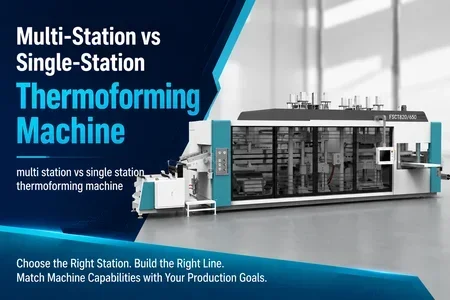
In thermoforming, the number of stations directly affects cycle time, tooling investment, and changeover flexibility. A single-station machine performs heating, forming, and trimming in one location, often requiring manual transfer or integrated robotics. A multi-station machine separates these functions into dedicated modules, enabling simultaneous operations and higher throughput.
Key operational distinctions:
- Cycle time: Multi-station machines can achieve shorter cycle times by overlapping heating and forming steps. Single-station machines typically have longer cycles since each step is sequential.
- Tooling cost: Single-station tooling is generally simpler and less expensive. Multi-station tooling requires matched sets for each station, increasing initial investment.
- Changeover: Single-station machines offer faster tooling changeovers, ideal for frequent product runs. Multi-station changeovers are more complex and time-consuming.
- Floor space: Multi-station systems occupy more floor area due to separate modules, while single-station designs are more compact.
For a deeper look at how these differences apply to cup production, see our multi station vs single station thermoforming machine comparison.
Why Station Count Matters for Production Efficiency and Cost?
The station count influences total cost of ownership (TCO) in several ways. Higher output per hour from a multi-station machine can reduce per-unit labor and overhead, but only if production volume justifies the premium. Single-station machines may offer lower upfront cost and greater flexibility for small batches or frequent product changes.
Decision factors:
- Volume threshold: If your annual output exceeds approximately 10 million units of a single SKU, multi-station configuration often yields lower unit costs.
- Product mix: High mix with short runs favors single-station ease of changeover.
- Material waste: Multi-station systems can reduce scrap through precise indexing, but require optimized sheet handling.
- Maintenance complexity: Single-station machines have fewer components, simplifying maintenance. Multi-station systems need more skilled technicians.
Key Procurement Considerations When Choosing a Thermoforming Machine
Before issuing an RFQ, procurement managers should validate these aspects with potential suppliers:
- Cycle time claims: Request certified cycle time data for your specific product (e.g., 12oz cup at 0.5mm wall thickness). Verify under consistent conditions.
- Tooling compatibility: Ensure the machine can accommodate your mold sizes and changeover mechanisms. Ask about tolerance specs.
- Automation level: Determine what auxiliary equipment is needed (stacking, curling, inspection) and whether the supplier offers integrated solutions.
- Service and training: Evaluate local support, spare parts availability, and training programs.
- Scalability: Check if the machine can be upgraded or expanded for future production increases.
When suppliers present options, ask for a side-by-side comparison of multi-station vs single-station thermoforming solutions for your target product family.
Phase: Validate Output Claims
Request a test run with your material. Measure actual cycle time versus supplier specification. Include drying, heating, and trimming segments. Document the basis for throughput projections.
How to Evaluate Suppliers and Prepare Your RFQ?
Start by creating a detailed RFQ document that includes product drawings, desired output volume, material specification, and quality standards. Then follow this evaluation workflow:
Step 1: Shortlist at Least Three Suppliers
Include both single-station and multi-station specialists. Request proposals with full technical data, pricing, and delivery timelines.
Step 2: Compare TCO Over Three Years
Factor in machine price, tooling, installation, energy consumption, maintenance, and operator training. Use a standardized spreadsheet.
Step 3: Visit Manufacturing Facility
Inspect build quality, reference installations, and verify after-sales support capabilities.
For example, a hypothetical medium-size producer running 16-hour shifts with two SKUs might find a single-station machine more cost-effective than a multi-station system. Conversely, a high-volume manufacturer with one main cup size may realize faster ROI with a multi-station approach. Always test assumptions with real data.
As part of your supplier evaluation, review how different vendors handle the multi station vs single station thermoforming trade-off for your specific application.
FAQ
What is the main advantage of a multi-station thermoforming machine over a single-station?
The primary advantage is higher output per hour due to overlapping process steps. Multi-station machines can achieve faster cycle times, making them suitable for large-volume production of standard products like cups and lids.
When should I choose a single-station thermoforming machine?
Single-station machines are ideal for small to medium volumes, frequent product changeovers, and limited floor space. They also involve lower initial tooling costs and simpler maintenance.
Does multi-station always mean higher quality?
Not necessarily. Quality depends on factors like heater control, mold precision, and material handling. Both configurations can produce high-quality parts when properly set up.
How much does a multi-station vs single-station thermoforming machine cost?
Prices vary widely based on size, automation, and brand. As a rough example, a single-station machine may range from $80,000 to $200,000, while a multi-station system can exceed $500,000. Always request detailed quotes.
Conclusion: Align Machine Choice with Production Reality
Choosing between a multi-station and single-station thermoforming machine requires balancing volume, flexibility, and total cost. For most buyers, the decision hinges on whether the throughput gain of a multi-station unit justifies its higher investment and complexity. Use the evaluation criteria and RFQ steps above to gather objective data from suppliers. Remember to visit the manufacturer’s facility and test with your own materials before committing.
For additional resources on thermoforming equipment, explore our plastic cup making machine and other auxiliary solutions.