English
 Pусский
 Español
 عربي
عربي

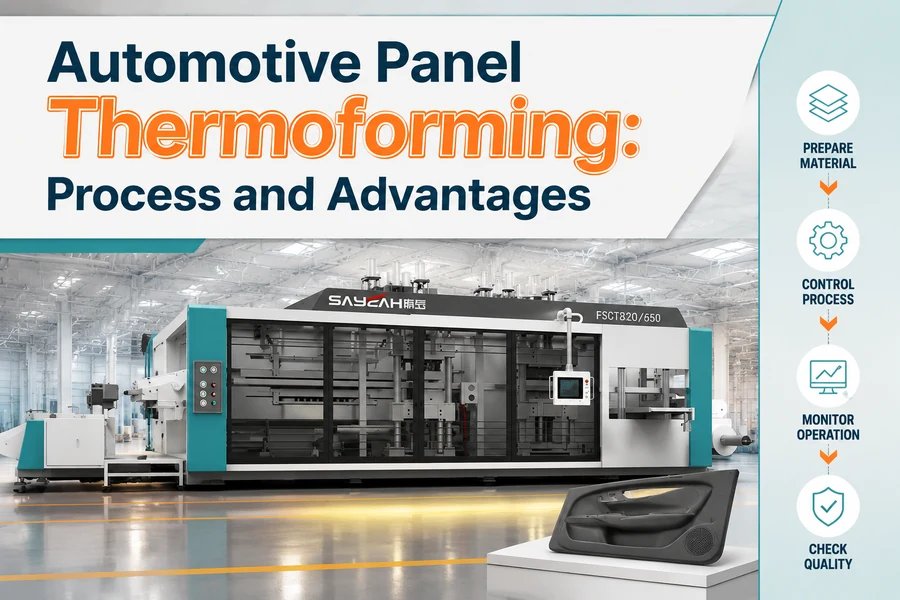
Automotive Panel Thermoforming: Process and Advantages
Article Overview: Automotive panel thermoforming is a heavy-gauge forming process for large interior and exterior trim panels. This article explains the working principle, typical sheet thickness (2–10 mm), common materials (ABS, PC/ABS, polypropylene), and key differences from injection molding. It is intended for CTOs, engineering managers, and technical buyers evaluating process options.
How Does Automotive Panel Thermoforming Work?
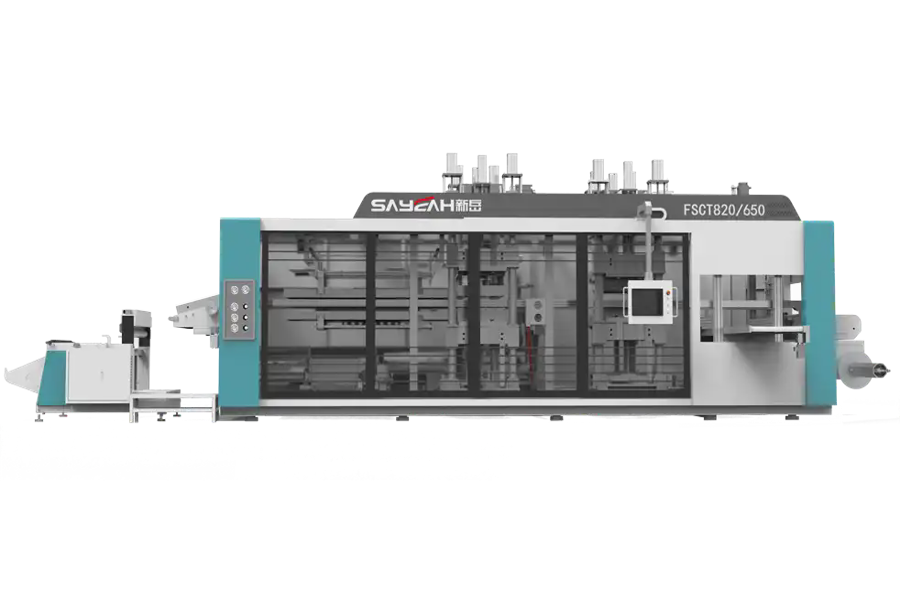
Automotive panel thermoforming heats a plastic sheet to a pliable temperature, forms it over a mold using vacuum or pressure, cools, and trims the part. This heavy-gauge cut-sheet process is suited for large panels up to several meters in size.
Step 1: Sheet Heating
The plastic sheet is clamped and conveyed through a heating station equipped with ceramic or quartz heaters. For heavy-gauge sheets (2–10 mm), heating time ranges from 30 seconds to several minutes depending on material and thickness. Uniform heating prevents localized thinning during forming.
Step 2: Forming
The heated sheet is positioned over a mold. Vacuum forming draws the sheet onto the mold surface; pressure forming (up to 4–5 bar) improves detail reproduction. For deep-draw automotive panels, a plug assist may be used to distribute material evenly.
Step 3: Cooling
Once formed, the part is cooled by fans or chilled air while held against the mold. Cooling time is critical to avoid warping; typical cycle times for automotive panels range from 30 to 90 seconds.
Step 4: Trimming
The formed panel is trimmed using a CNC router, punch, or waterjet to remove excess material and achieve final dimensions. Trimming can be integrated into the forming station or performed offline.
For a comprehensive guide on selecting equipment, see the How to Choose a Thermoforming Machine Guide.
What sheet thickness is typical for automotive panel thermoforming?
Automotive panel thermoforming typically uses sheet thicknesses ranging from 2 mm to 10 mm, classifying it as heavy-gauge thermoforming. Thinner sheets (2–4 mm) are common for interior trim, while thicker sheets (5–10 mm) are used for structural or exterior panels.
| Application | Thickness Range | Example Parts |
|---|---|---|
| Interior trim | 2–4 mm | Door panels, pillar covers |
| Dashboard components | 3–5 mm | Instrument panel bezels |
| Exterior panels | 5–10 mm | Bumper covers, body cladding |
Thicker sheets require longer heating and cooling times, and may require pressure forming to achieve sufficient detail. Sheet thickness directly affects cycle time and material cost. For a more detailed comparison of thin-gauge vs heavy-gauge thermoforming, learn the differences between thin-gauge and heavy-gauge thermoforming.
How does thermoforming compare to injection molding for automotive panels?
Thermoforming offers lower tooling costs and the ability to produce very large parts, while injection molding provides tighter tolerances and higher production rates for complex geometries. For large panels in low to medium volumes, thermoforming is often more cost-effective.
Comparison: Thermoforming vs Injection Molding
- Tooling Cost
- Thermoforming: Low (typically $10,000–$100,000 per mold). Injection molding: High (typically $100,000–$1,000,000+ per mold).
- Part Size
- Thermoforming: Up to 4×2 m or larger. Injection molding: Limited by machine clamp tonnage.
- Production Volume
- Thermoforming: Economical for 500–50,000 parts/year. Injection molding: Best for >50,000 parts/year.
- Surface Detail
- Thermoforming: Moderate. Injection molding: High.
- Lead Time
- Thermoforming: Weeks. Injection molding: Months.
When evaluating suppliers for your thermoforming line, consult the Top Thermoforming Machine Manufacturers: Procurement Guide - Sayeah Machinery to identify qualified partners.
What materials are used in automotive panel thermoforming?
Common materials include ABS, PC/ABS blends, polypropylene, and sometimes acrylic or PVC. ABS offers good impact resistance and surface finish for interior panels; PC/ABS provides higher heat resistance for under-dash applications; polypropylene is chosen for chemical resistance and low cost.
| Material | Key Properties | Typical Applications |
|---|---|---|
| ABS | Good impact strength, good surface finish, low cost | Interior trim, door panels, glove boxes |
| PC/ABS | Higher heat deflection, better ductility than ABS alone | Dashboard bezels, air vents, instrument panel |
| Polypropylene (PP) | Chemical resistance, low density, recyclable | Under-hood insulators, battery trays |
Material selection also influences forming temperature (e.g., ABS at 140–180°C, PC/ABS at 160–200°C, PP at 160–190°C) and mold shrinkage. Always verify material compatibility with your forming process before production.
FAQ
What is the typical cycle time for automotive panel thermoforming?
Cycle times vary by part size and thickness, typically ranging from 45 seconds to 3 minutes per part. Thicker sheets and larger parts require longer heating and cooling phases.
Can thermoformed panels achieve a Class A surface finish?
Yes, with polished molds and careful process control, thermoforming can achieve Class A surfaces suitable for visible interior panels. Exterior panels may require secondary painting or film lamination.
What is the typical tooling investment for automotive panel thermoforming?
Tooling costs range from $10,000 to $100,000 depending on part complexity, material, and mold material (aluminum, steel, or composite). This is significantly lower than injection molding tooling.
Conclusion
Automotive panel thermoforming is a proven process for producing large, complex parts with lower tooling investment and faster lead times than injection molding. Typical sheet thicknesses of 2–10 mm and materials such as ABS, PC/ABS, and polypropylene make it suitable for a wide range of interior and exterior applications. By understanding the process sequence, material behavior, and equipment requirements, procurement teams can make informed decisions when evaluating this manufacturing method.