English
 Pусский
 Español
 عربي
عربي

Two Types of Thermoforming: Key Differences
Article Overview: This article provides a neutral, analytical comparison of the two types of thermoforming—thin-gauge (roll-fed) and heavy-gauge (cut-sheet)—as well as the vacuum and pressure forming variants. It offers a decision framework for procurement teams, technical architects, and buyers evaluating process fit, material usage, and production scale.
Understanding the Two Types of Thermoforming: Thin-Gauge vs Heavy-Gauge
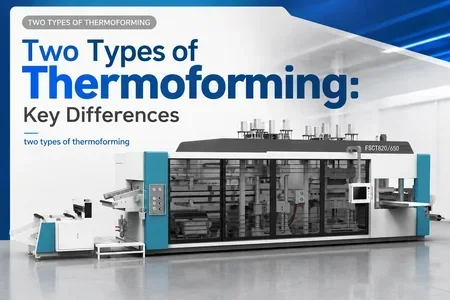
Thermoforming is a manufacturing process where a plastic sheet is heated to a pliable forming temperature, shaped in a mold, and trimmed to create a finished product. The two primary types of thermoforming are defined by material thickness: thin-gauge (typically 0.1 mm to 2 mm) and heavy-gauge (typically 2 mm to 10 mm or more). Each type suits different applications, volumes, and cost structures.
Option A: Thin-Gauge (Roll-Fed)
Continuous roll-fed process. High output rates (up to tens of thousands of parts per hour). Typical applications: disposable cups, lids, trays, and food containers. Sheet thickness below 2 mm. Lower material cost per part but requires significant tooling investment. Ideal for long-run, high-volume production.
Option B: Heavy-Gauge (Cut-Sheet)
Individual sheets fed manually or automatically. Lower output rates (hundreds to low thousands per hour). Typical applications: automotive panels, refrigerator liners, boat hulls, medical device housings, and large industrial parts. Sheet thickness above 2 mm. Higher material cost per part but lower tooling cost. Suitable for short runs, large parts, or frequent design changes.
Buyer note: Thin-gauge is often chosen for packaging and high-volume items; heavy-gauge for durable goods with structural requirements. Your annual volume, part size, and unit cost targets will drive the choice.
How Do Vacuum and Pressure Thermoforming Differ?
Within each gauge type, the forming method can be vacuum, pressure, or a combination. Vacuum forming uses atmospheric pressure to draw the heated sheet against a mold. Pressure forming uses compressed air (often 4–7 bar) to push the sheet into the mold cavity. The two types of thermoforming methods produce different detail levels and surface finishes.
Option A: Vacuum Forming
Simpler system, lower tooling and equipment cost. Suitable for moderate detail. Maximum draw ratio limited by vacuum differential. Best for parts with gentle contours and uniform wall thickness. Common in packaging, signage, and simple enclosures.
Option B: Pressure Forming
Higher detail reproduction and sharper features. Can form deeper draws with thinner walls. Requires reinforced molds and an air compressor. Higher energy cost but enables textured surfaces and undercuts. Used for high-visibility consumer goods, automotive interior panels, and medical device covers.
Buyer note: If your design demands sharp edges, grain textures, or tight tolerances, pressure forming is typically required. For simple shapes and cost sensitivity, vacuum forming often suffices.
Both methods can be applied to either thin-gauge or heavy-gauge sheets, but pressure forming is more common in heavy-gauge due to the higher forces needed to move thicker material.
What Are the Tradeoffs Between Vacuum and Pressure Forming?
Beyond the basic differences, understanding tradeoffs helps refine your selection. Vacuum forming has lower tooling and operating costs but limited surface detail and deeper draw capability. Pressure forming offers higher quality and design freedom but at a premium. Consider these factors:
- Tooling complexity: Pressure forming requires molds that withstand 4–7 bar, often made from aluminum or steel; vacuum forming can use cheaper epoxy or composite molds.
- Cycle time: Pressure forming may add a few seconds per cycle due to compressed air setup, but this is often offset by reduced post-processing.
- Material utilization: Pressure forming can achieve thinner walls in deep draws, reducing material weight per part, which may offset higher energy costs.
- Post-processing: Vacuum-formed parts may require more trimming and finishing; pressure-formed parts often have cleaner edges and better surface finish.
For most applications, vacuum forming is adequate for parts where aesthetics are secondary. If your product demands high visual appeal or functional features like snap fits, pressure forming is the better route.
Key Criteria for Choosing Between the Two Types of Thermoforming
Procurement teams should evaluate the following factors systematically. The table below summarizes the primary specifications that differentiate thin-gauge from heavy-gauge thermoforming.
| Parameter | Thin-Gauge (Roll-Fed) | Heavy-Gauge (Cut-Sheet) |
|---|---|---|
| Sheet thickness range | 0.1–2 mm | 2–10+ mm |
| Typical output rate | 5,000–30,000 parts/hour | 100–1,000 parts/hour |
| Tooling investment | High (multi-cavity aluminum molds) | Low to moderate (aluminum or composite molds) |
| Part size capability | Limited by web width (typically <1.2 m width & draw depth <200 mm) | Large parts possible (up to 3 m x 2 m or more) |
| Material cost per part | Low (commodity resins) | Higher (engineering resins common) |
| Lead time for tooling | 6–12 weeks | 2–6 weeks |
| Typical applications | Packaging, cups, trays, lids | Automotive panels, equipment housings, boat hulls |
Use this checklist to align process selection with your product requirements:
- Production volume: Thin-gauge roll-fed excels above 1 million units/year; heavy-gauge cut-sheet is economical below 100,000 units/year.
- Part size and geometry: Heavy-gauge handles large parts (e.g., 2 m x 1 m) without splitting; thin-gauge is limited by web width and draw depth.
- Material options: Thin-gauge uses commodity resins (PS, PP, PET); heavy-gauge can use engineering resins (ABS, PC, ASA).
- Tooling investment: Thin-gauge requires high-cost, long-lead aluminum molds; heavy-gauge can use cost-effective aluminum or composite molds.
- Lead time: Heavy-gauge offers faster tooling cycles (weeks vs months for thin-gauge multi-cavity tools).
- Certification requirements: Food contact, UV resistance, flame retardancy – each type can meet standards, but heavy-gauge often requires additional testing.
For a deeper look at how these types of thermoforming apply to cup production, see our detailed guide on types of thermoforming for plastic cup making.
Which Type of Thermoforming Fits Your Production Volume?
Volume is often the deciding factor. Use the following step-by-step evaluation to map your case.
Step 1: Estimate annual demand
Forecast yearly part quantity, including potential growth. If volume exceeds 500,000 units, thin-gauge roll-fed becomes increasingly cost-effective due to lower per-part material and cycle time. Below 50,000 units, heavy-gauge cut-sheet reduces risk of over-investment.
Step 2: Define part complexity and size
Measure the part envelope (length x width x depth). For parts larger than 1 m in any dimension, heavy-gauge is typically necessary. For parts requiring high detail (e.g., ribbing, logos, texture), pressure forming within the heavy-gauge category may be required.
Step 3: Evaluate total cost of ownership
Include tooling amortization, scrap rate, energy consumption, and labor. Thin-gauge lines often require fewer operators but have higher power draw. Heavy-gauge lines are more flexible but may require manual trimming and finishing. Run a total cost analysis for your production horizon.
By following these steps, you can narrow your selection to the two types of thermoforming that match your operational reality. For additional background on the machinery involved, visit our plastic sheet extruder overview, which feeds material into both process types.
Application Scenarios for Each Type of Thermoforming
Understanding real-world applications helps illustrate the tradeoffs. Below are common use cases for each type:
- Thin-gauge thermoforming: Disposable coffee cups (PP or PS), fruit containers (PET), blister packs, yogurt cups, deli trays, and single-use cutlery. High production runs and low per-unit cost drive adoption.
- Heavy-gauge thermoforming: Automotive dashboards (ABS), refrigerator liners (HIPS), medical device enclosures (PC/ABS), boat hulls (HDPE), and large signage panels. Durability, impact resistance, and ability to produce large, complex shapes are key.
Both types can incorporate vacuum or pressure forming depending on detail requirements. For instance, a thin-gauge lid with a snap-fit design may benefit from pressure forming, while a heavy-gauge structural cover may rely on vacuum forming to reduce cost.
FAQ
What are the two types of thermoforming?
The two main types are thin-gauge (roll-fed) thermoforming for high-volume, lightweight parts, and heavy-gauge (cut-sheet) thermoforming for lower-volume, larger, or more complex parts. Within each type, vacuum and pressure forming methods can be used.
Which type of thermoforming is best for food packaging?
Thin-gauge thermoforming (both vacuum and pressure variants) dominates food packaging because it produces lightweight, disposable containers at high speed. Examples include fruit trays, yogurt cups, and deli containers.
Can pressure forming be used with thin-gauge sheets?
Yes, pressure forming can be applied to thin-gauge sheets to achieve sharper details, though it is less common due to added cost. It is often used for high-end packaging where aesthetic differentiation matters.
What materials are compatible with heavy-gauge thermoforming?
Heavy-gauge thermoforming supports a wide range of thermoplastics, including ABS, polycarbonate, acrylic, HDPE, and polypropylene. Material selection depends on the part’s mechanical, thermal, and aesthetic requirements.
Is thermoforming the same as vacuum forming?
No. Vacuum forming is one method within thermoforming. Thermoforming also includes pressure forming, mechanical forming, and twin-sheet forming. The two types of thermoforming (thin- and heavy-gauge) each incorporate these methods.
What are the cost implications of choosing between the two types of thermoforming?
Thin-gauge has lower per-part material cost but higher tooling investment, making it cost-effective at high volumes. Heavy-gauge has higher per-part material cost but lower tooling cost, making it suitable for low to medium volumes and large parts. Total cost of ownership analysis is recommended.
Can the same material be used in both thin-gauge and heavy-gauge thermoforming?
Yes, many materials like PP, PS, and ABS are available in both thin and thick sheets. However, heavy-gauge often uses specialized grades to meet structural and fire-rating requirements.
Conclusion
Understanding the two types of thermoforming—thin-gauge versus heavy-gauge—and the associated vacuum and pressure methods is essential for making a cost-effective, technically sound process decision. This guide has outlined the key differences in material thickness, production volume, tooling investment, and forming capability. By applying the evaluation framework provided, buyers can objectively select the approach that aligns with their product specifications and business case. For a comprehensive view of the equipment used, explore our types of thermoforming system for high-volume production to see how these types of thermoforming are implemented in a production line.