English
 Pусский
 Español
 عربي
عربي

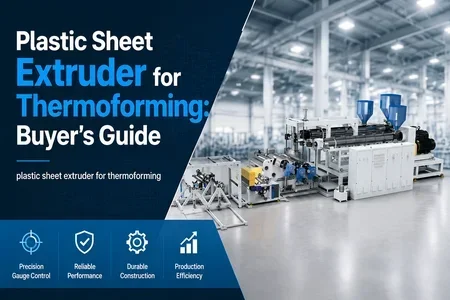
Plastic Sheet Extruder for Thermoforming: Buyer's Guide
Article Overview: This guide helps procurement managers, project engineers, and sourcing teams evaluate suppliers of plastic sheet extruders for thermoforming. It covers critical specifications, a step-by-step RFQ preparation process, supplier evaluation criteria, and common pitfalls. The focus is on reducing procurement risk and ensuring the extruder aligns with your thermoforming line requirements.
What to Look for in a Plastic Sheet Extruder for Thermoforming?
When sourcing a plastic sheet extruder thermoforming system, the extruder’s ability to produce consistent, uniform sheet thickness is paramount. Thermoforming processes depend on precise gauge control to avoid thinning or warping in formed parts. Key specifications to evaluate include:
- Screw design and L/D ratio – A higher L/D ratio (typically 30:1 to 36:1) improves melt homogeneity, critical for thin-gauge sheet used in cup forming.
- Melt temperature control – Multiple barrel heating zones and automated cooling prevent thermal degradation.
- Die design – Adjustable flex-lip or automatic die systems enable real‑time gauge adjustment.
- Throughput capacity – Match the extruder’s kg/hr output to your thermoforming machine’s sheet demand (e.g., 300–800 kg/hr for average cup lines).
- Material compatibility – Verify the extruder can process PP, PET, PS, or PLA if you plan to switch materials.
A supplier should provide documented tests for gauge variation (usually ≤±3%) and melt flow index consistency. Request a trial run with your target resin before committing.
How to Evaluate Plastic Sheet Extruder Thermoforming Suppliers?
Supplier evaluation goes beyond price. Use a structured scoring system covering technical capability, service support, and track record. Below are the essential checkpoints:
- Machine trials – Ask for witness tests of sheet thickness uniformity across the full width.
- Component quality – Inquire about brands of screw, barrel, gearbox, and drives (e.g., Siemens, ABB, or SEW).
- After-sales support – Confirm response time, spare parts availability, and training for your maintenance staff.
- References – Request contact details of three buyers in your industry (e.g., cup or lid thermoforming).
- Certifications – CE, UL, or ISO 9001 can indicate consistent manufacturing quality.
Use a scorecard with weighted criteria: 40% process performance, 30% reliability, 20% support, 10% cost. This reduces the risk of selecting a supplier based solely on the lowest quote.
Step‑by‑Step RFQ Preparation for Plastic Sheet Extruders
An effective RFQ reduces misinterpretation and speeds up supplier comparison. Follow this workflow:
Step 1: Define throughput and material range
Specify the target output (kg/hr), the polymers you intend to run, and the gauge range (e.g., 0.3–2.0 mm). Include any future materials you may adopt.
Step 2: Outline sheet dimensions and roll handling
State required sheet width, roll diameter, and core size. If your thermoformer uses a specific unwind stand, mention the adapter specifications.
Step 3: Request performance guarantees
Ask for guaranteed gauge tolerance, edge trim scrap rates, and energy consumption (kWh/kg). Demand a penalty clause for non‑performance.
Step 4: Compare total cost of ownership
Request pricing for consumables (screw, barrel, screens), estimated annual maintenance costs, and upgrade paths. A cheaper initial price may hide higher operating costs.
Common Procurement Mistakes and How to Avoid Them
Many buyers focus on throughput alone and overlook integration risks. For a plastic sheet extruder thermoforming solution, the extruder must synchronize with the former’s indexing speed. Common mistakes include:
- Ignoring die‑to‑former distance – If the sheet cools too much before forming, defects appear. Ensure the extruder’s exit matches the former’s infeed design.
- Underestimating scrap handling – A plastic sheet extruder for thermoforming lines should include an inline crusher or trim recycling system to return scrap directly to the extruder.
- Skipping site readiness – Check floor space, electrical supply (voltage, phase), and cooling water capacity before ordering.
- Neglecting operator training – Complex extruder controls require at least one week of on‑site training for your team.
FAQ
What is the typical payback period for a plastic sheet extruder for thermoforming?
Payback depends on volume, scrap reduction, and energy savings. For a mid‑range extruder processing 400 kg/hr of PP, many buyers report payback within 18–24 months based on material cost savings alone. Verify with your specific resin prices.
Can I use a plastic sheet extruder thermoforming system for both PP and PET?
Yes, but it requires a dual‑purpose screw design and additional barrel cooling zones. Ask the supplier for a material‑changeover procedure and estimated purge material loss.
How do I compare the quality of different extruders?
Focus on three metrics: gauge variation (≤3%), melt temperature consistency (±2°C), and specific energy consumption. Ask for test reports from a third‑party lab if available.
What maintenance is required for a plastic sheet extruder for thermoforming?
Routine maintenance includes screen pack changes (every 2–4 weeks), screw and barrel wear checks (annually), and gearbox oil analysis. Suppliers often offer preventive maintenance contracts.
Conclusion
Selecting a plastic sheet extruder for thermoforming is a strategic investment that directly impacts your formed product quality and production uptime. By following the RFQ steps, evaluating suppliers against objective criteria, and avoiding common oversights, you can secure a machine that performs reliably for years. Start your procurement process by defining your sheet requirements precisely and requesting technical data from at least three qualified vendors. For further support, review the specifications of multi‑station thermoforming machines that pair with extruders in integrated lines.