English
 Pусский
 Español
 عربي
عربي

Thermoforming vs Injection Molding for Plastic Packaging
Article Overview: This guide helps procurement managers and project engineers compare thermoforming and injection molding for plastic packaging applications. We cover cost drivers, design limitations, material efficiency, and actionable RFQ criteria to support supplier evaluation and purchasing decisions. The decision between thermoforming vs injection molding directly impacts tooling investment, per-part cost, and production lead times.
What Are the Key Differences Between Thermoforming and Injection Molding?
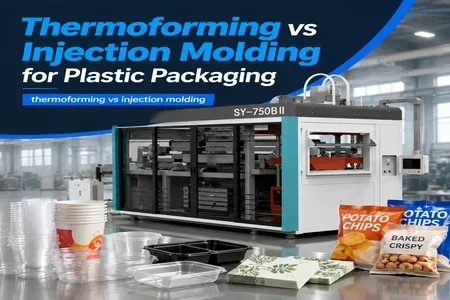
Thermoforming and injection molding are both widely used for plastic parts, but they differ fundamentally in process, tooling, and cost structure. Thermoforming heats a plastic sheet and forms it over a mold using vacuum or pressure. Injection molding melts plastic pellets and injects the molten material into a closed metal mold under high pressure.
- Tooling cost: Thermoforming molds (often aluminum or composite) are significantly less expensive than injection molds (hardened steel). Thermoforming tooling can cost 50-80% less for similar part complexity.
- Cycle time: Injection molding typically produces parts in seconds; thermoforming cycles range from a few seconds to over a minute depending on sheet thickness and cooling.
- Design flexibility: Thermoforming allows larger parts with thinner walls but limited undercuts. Injection molding offers tighter tolerances and complex geometries including threads and inserts.
- Material waste: Thermoforming generates trim scrap (typically 15-30% of sheet) which can often be reground and reused. Injection molding has minimal runner waste but higher energy consumption per part.
For packaging applications such as cups, trays, lids, and containers, thermoforming is often the preferred choice for medium-to-high volumes due to lower tooling costs and faster time to market. Injection molding may be selected for high-volume, precision components like tamper-evident closures or multi-layer barrier structures.
How to Evaluate Tooling Costs and Volume Requirements?
Tooling cost is one of the most critical factors when choosing between thermoforming vs injection molding. The breakeven volume between the two processes depends on part geometry and material.
Example Scenario: Plastic Cup Production
Option A: Thermoforming
Mold cost: $3,000 – $10,000 per cavity
Cycle time: 20–40 seconds per sheet (multiple parts)
Scrap rate: 15–25% (recyclable)
Option B: Injection Molding
Mold cost: $15,000 – $50,000 per cavity
Cycle time: 5–10 seconds per shot
Scrap rate: 2–5% (sprues/runners)
Buyer note: For annual volumes below 500,000 units, thermoforming typically offers a lower total cost. For volumes above 2 million units, injection molding's faster cycle times can offset its higher tooling investment, especially if multiple cavities are used.
When preparing your RFQ, request pricing at multiple volume tiers (e.g., 100K, 500K, 1M, 5M parts per year) to identify the crossover point. Include tooling amortization in your unit cost calculation.
Material Selection and Waste Considerations
Both processes support a range of thermoplastics, but material form and handling differ. Thermoforming uses pre-extruded sheets, while injection molding uses pellets. Common materials for packaging include PP, PS, PET, and PLA.
| Factor | Thermoforming | Injection Molding |
|---|---|---|
| Material form | Sheet (roll or cut) | Pellets |
| Color change time | Minutes (sheet change) | Hours (barrel purge) |
| Scrap reuse | Regrind into sheet back to extruder | Grind runners, blend with virgin |
| Wall thickness uniformity | Good, but thick thin areas | Excellent, repeatable |
For sustainability-focused buyers, thermoforming's ability to incorporate high percentages of post-consumer recycled (PCR) material into the sheet—often 20–100%—can be an advantage. However, injection molding can achieve thinner walls in some geometries, reducing material use per part.
Why Application Fit Matters in Thermoforming vs Injection Molding Packaging?
The final decision should be driven by the specific packaging application. Thermoforming excels in open-top containers, clamshells, and trays with moderate draft angles. Injection molding is better for parts requiring tight dimensional accuracy, threaded features, or multi-material overmolding.
For example, a thermoforming vs injection molding packaging solution for yogurt cups often favors thermoforming due to cost and speed. Conversely, a high-precision pill bottle with child-resistant closure might require injection molding. Evaluate your part's aspect ratio, undercuts, and required tolerances before selecting a process.
Additionally, consider the production volume stability. If your demand fluctuates, thermoforming's lower tooling investment reduces financial risk. Injection molding's higher fixed costs require steady, high volumes to be economical.
Supplier Evaluation Checklist for RFQ Preparation
When you send an RFQ for thermoforming vs injection molding packaging, use the following steps to ensure a comprehensive quote evaluation:
Step 1: Define Part Specifications
Provide CAD files, critical dimensions, material grade, color/regrind allowances, and packaging type (stackable, nestable, etc.). Include any regulatory requirements (FDA, EU food contact).
Step 2: Request Process-Specific Quotes
Ask each supplier to quote both processes if they offer both. If they specialize, compare quotes from multiple suppliers. Request tooling cost, cycle time, and per-part cost at your target volumes.
Step 3: Validate Quality and Lead Times
Ask for sample parts, dimensional report, and a production timeline. Inquire about tooling warranty, maintenance support, and post-production services (trimming, decorating, assembly).
Step 4: Evaluate Total Cost of Ownership
Include tooling amortization, scrap cost, energy consumption, and logistics (e.g., nesting density for thermoformed parts reduces shipping cost). For the thermoforming vs injection molding packaging approach, calculate the cost per thousand parts over three years.
- Confirm the supplier's material sourcing and testing capabilities.
- Review their quality certifications (ISO 9001, BRC, etc.).
- Assess their capacity for secondary operations (printing, lidding, stacking).
- Request references from similar packaging projects.
FAQ
What is the main cost advantage of thermoforming over injection molding for packaging?
Thermoforming has significantly lower tooling costs—often 50-80% less than injection molding. This makes it more affordable for medium-volume production runs (under 1 million units per year).
Can thermoforming achieve tight tolerances like injection molding?
Thermoforming generally offers looser tolerances (typically ±0.5 mm or more) compared to injection molding (±0.1 mm). For critical fit or seal surfaces, injection molding is recommended.
Which process is more environmentally friendly?
Both have sustainability trade-offs. Thermoforming's scrap can be reground and reused in the extruder, and it can run high PCR content. Injection molding produces less scrap but consumes more energy per part due to high pressure and heating.
How do I decide which process to use for my plastic cup project?
Consider your annual volume, budget for tooling, required wall thickness, and design complexity. For most single-wall cup designs, thermoforming is cost-effective. For multi-layer or barrier cups, injection molding may be necessary. Contact a thermoforming vs injection molding packaging solution specialist for a tailored analysis.
Conclusion
Choosing between thermoforming vs injection molding for plastic packaging requires a clear understanding of tooling cost, volume thresholds, material needs, and part geometry. Procurement managers should use a data-driven RFQ process that compares total cost across multiple volume scenarios. By following the supplier evaluation checklist and the flow steps outlined above, you can reduce procurement risk and select the most cost-effective process for your packaging application. Evaluate your options early, request sample parts, and partner with suppliers who offer transparent pricing and process expertise.