English
 Pусский
 Español
 عربي
عربي

Extruder Comparison for Plastic Sheet Production
Article Overview: Choosing the right extruder technology for plastic sheet production requires a systematic comparison of technical capabilities, operational fit, and downstream integration. This article provides a neutral analytical framework for CTOs, technical architects, and procurement teams evaluating single-layer and multi-layer extrusion lines. We examine key differences, specification trade-offs, and decision checkpoints to support objective supplier selection.
What are the key differences between single-layer and multi-layer extruders?
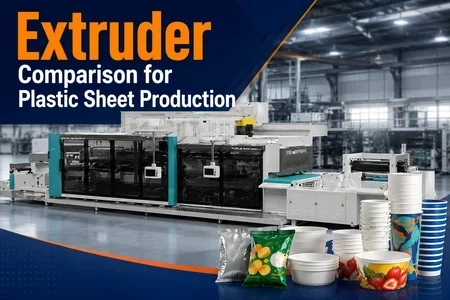
Single-layer extruders produce homogeneous sheets from one polymer. Multi-layer co-extruders combine two or more materials in a single die to create sheets with distinct functional layers. The primary difference lies in structure: a single-screw or twin-screw extruder feeds one melt stream, while a multi-layer line uses multiple extruders feeding a co-extrusion feedblock or multi-manifold die. This allows properties like barrier, color, or mechanical strength to be distributed across layers.
Multi-layer systems offer greater flexibility but increase complexity. For example, a three-layer sheet can combine recycled core material with virgin surface layers for food contact compliance. However, such lines require precise melt temperature and viscosity matching between layers. For typical cup forming applications, a Plastic Sheet Extruder for thermoforming must be sized to match the thermoformer’s output—process considerations should drive machinery selection.
- Single-layer: Lower capital cost, simpler operation, suitable for commodity products where barrier requirements are minimal.
- Multi-layer: Higher upfront investment, more skilled maintenance needed, enables differentiated product properties like oxygen barrier or heat sealability.
How do extruder specifications affect downstream thermoforming?
The extruder’s output rate, melt temperature uniformity, and sheet thickness tolerance directly influence thermoforming efficiency. A variable-speed drive and temperature-controlled barrel sections allow fine-tuning. For example, if a Multi Station Thermoforming Machine runs at 30 cycles per minute, the extruder must supply sheet at a consistent width and gauge to prevent bridging or thin spots. Inefficient temperature control can cause uneven sag, leading to higher scrap rates.
Another key parameter is die gap adjustment. Manual or automatic die bolts affect thickness profile. Multi-layer dies require careful setup to avoid layer non-uniformity. Procurement teams should request melt flow index (MFI) compatibility data for all layers. Without this, delamination risks increase. A buyer’s evaluation should include a technical questionnaire covering melt temperature range, screw design (barrier vs. general-purpose), and filtration system (screen changer type and mesh size).
Specification comparison for extruder selection
When comparing extruder options, focus on parameters that impact your line productivity and product quality. The table below outlines typical considerations; verify exact specifications with shortlisted suppliers.
Key specification comparison
| Criterion | Single-Layer | Multi-Layer | Buyer Note |
|---|---|---|---|
| Number of material streams | 1 | 2–5 (typical) | More streams increase complexity |
| Maximum sheet width | Varies by configuration | Varies by configuration | Must match downstream trim/rewind |
| Typical output (kg/h) | Varies by configuration | Varies by configuration | Depends on screw diameter and RPM |
| Layer uniformity | Not applicable | Validate against your spec | Test using cross-section microscopy |
| Energy consumption | Depends on line setup | Depends on line setup | Include barrel heating and cooling |
| Screw design options | General purpose, barrier | Custom per polymer | Shear-sensitive materials need gentle screws |
Decision checkpoint: Map your product portfolio to layer requirements first. A single-layer line is sufficient if all products use a single polymer and no barrier is needed. Multi-layer becomes necessary when recyclate incorporation or high barrier is required. Always include a Plastic Cup Making Machine in the line capacity calculation to avoid bottlenecks.
Operational implications and integration considerations
Extruder selection impacts not only initial cost but also ongoing operations. Evaluate the following operational factors:
- Changeover time: Multi-layer systems require purging all extruders when switching materials, increasing downtime. Single-layer lines swap materials faster.
- Maintenance complexity: Co-extrusion dies with multiple feed channels need more frequent cleaning and calibration. Auxiliary Equipment such as an online crusher can help reclaim start-up scrap but adds to system complexity.
- Operator skill level: Multi-layer lines demand deeper understanding of polymer rheology. Budget for training or consider automation to reduce manual handling errors.
- Future scalability: A modular multi-layer system can be expanded later by adding extruder modules. Verify if your supplier offers this flexibility.
Integrating the extruder with upstream silos and downstream finishing machines requires careful layout planning. The extruder should be positioned to minimize melt pipe length, especially for heat-sensitive materials. Use automated sheet handling to streamline operations. For companies new to co-extrusion, partnering with a turnkey supplier who also provides technical support and commissioning can reduce risk.
FAQ
What are the main trade-offs between single-layer and multi-layer extruders?
The main trade-offs are capital cost vs. product differentiation. Single-layer extruders are simpler and cheaper but limit you to homogeneous sheets. Multi-layer extruders allow combining properties (e.g., recycled core with virgin surface) but require higher investment and more skilled operation.
How do I determine the required extruder output for my thermoforming line?
Calculate based on your thermoforming machine’s maximum cycles per minute, mold cavity area, sheet thickness, and trim scrap percentage. Add 10–15% buffer for startup. The Application Center can help run a line capacity simulation. Always validate against your actual product mix.
Is it better to buy a co-extruder from a dedicated supplier or a general machinery maker?
That depends on your technical support needs. Dedicated co-extrusion specialists often have deeper process knowledge for multi-layer adhesion. General machinery makers may offer better integration with a full line (extruder + thermoformer + downstream). Request references for similar polymer combinations and throughput levels.
What quality documentation should I request during extruder evaluation?
Ask for screw and barrel metallurgy certificates, die design drawings, melt pump specifications (if used), and previous FAT reports. Also request a layer distribution analysis for multi-layer dies. If the supplier has ISO certification, review their quality procedures for consistency.
Conclusion: Build your extruder decision on process-first logic
Selecting between single-layer and multi-layer extruders is not a question of which is “better” but which matches your production objectives. Start by defining your product requirements—material variety, barrier needs, output volume—then evaluate extruder specifications within the context of your entire line. Use the comparison table and operational checklist provided here as starting points. Always involve your process engineering team in supplier discussions and request trial runs if possible. A well-sized extruder, whether single-layer or multi-layer, should be selected as part of a coherent production line strategy where process leads machinery choice. For further guidance, explore the Plastic Sheet Extruder solution and related resources on our site.