English
 Pусский
 Español
 عربي
عربي

How to Pick the Right Plastic Thermoforming Equipment
Every production manager remembers that one project where the new line just didn’t click. The cycle was slow. The sheet distribution was uneven. You spent weeks on calibration, only to realize the machine’s specs were a mismatch for your molds.
In the thermoforming industry, this scenario is surprisingly common. It’s rarely about the machine being “bad.” It’s about the fit.
If you are in the market for new forming machinery, you are likely juggling competing priorities: cycle speed, material compatibility, tooling changeover time, and energy costs. The technical brochures all look similar. But beneath the surface, specific engineering choices will dictate whether a machine becomes the hero of your factory floor or a perpetual bottleneck.
Let’s walk through the real-world criteria that matter when evaluating these systems.
The Hidden Cost of “Universal” Designs
Many buyers default to a “universal” platform because it feels safe. However, a machine built for everything is often optimized for nothing. According to industry feedback from packaging engineers, the most frequent pain point isn’t forming speed—it’s post-processing consistency (trimming and stacking).
A high-speed former is useless if the stack press jams every 500 cycles.
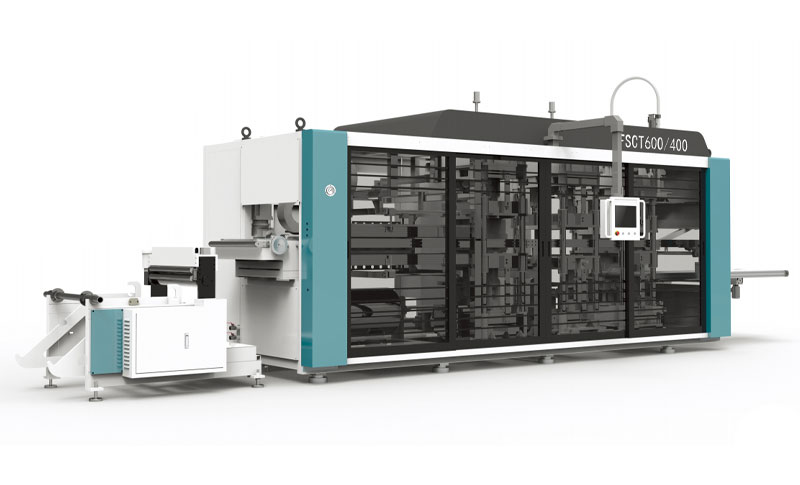
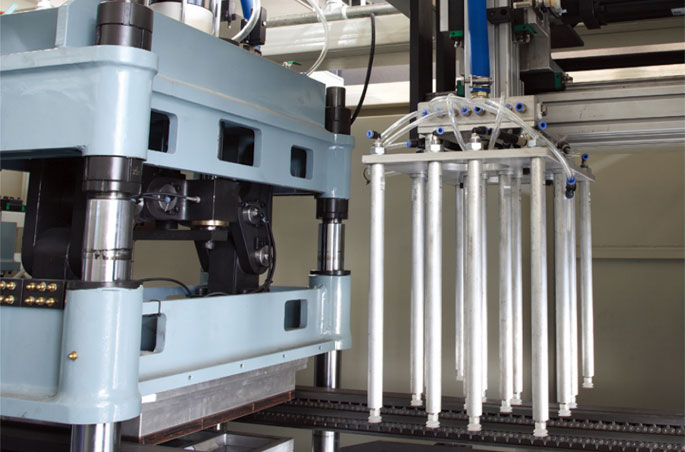
When you look at a production line, ignore the brand logo for a second. Instead, look at the mechanical separation between forming and cutting. In an in-line system, vibrations from the cutting station can distort the plastic while it is still warm, leading to dimensional drift. A modular design, where the forming station operates independently from the trimming station, offers better stability for high-precision items like thin-wall cups or deli containers.
Pro Tip: Ask the supplier for the "decoupling time" between forming and cutting. A longer decoupling time allows the plastic to cool naturally before being cut, reducing cracking defects by an estimated 15-20% (based on standard ASTM D638 testing references).
Parameter #1: The Toggle vs. Servo Debate
Most entry-level evaluations stop at “electric vs. hydraulic.” But the real differentiation lies in the drive mechanism for the forming platen.
-
Mechanical Toggle: Great for brute force and high-speed continuous forming (think disposable lids). However, it offers limited control over the forming depth. If your product portfolio includes varying depths (e.g., both 50ml cups and 500ml bowls), changing the depth requires physical adjustments.
-
Servo-Electric Platen: Offers programmable depth and pressure. You can save recipes for different SKUs. The upfront cost is higher, but changeover time drops from 45 minutes to under 5 minutes.
If you run a high-mix, low-volume facility, the servo-actuated platen is the obvious choice. If you run a single SKU at millions of units per month, the mechanical toggle is still competitive.
Parameter #2: Heating Oven Configuration
This is where efficiency lives or dies. Ceramic heaters are cheap and robust, but they respond slowly. Infrared (IR) emitters heat up and cool down instantly.
Look for zoned heating control. A low-end machine might have 10 zones. A well-configured system will have 40+ zones across the width of the sheet. Why does this matter? If your mold has a complex geometry (deep draw in the center, shallow on the edges), you need center zones hotter than the edges. Without independent zone control, you will experience webbing or thinning.
Common Operation Mistakes (And How Design Prevents Them)
Even with the best equipment, operators make mistakes. The best machines mitigate these risks with automation.
-
Mistake 1: Starting the cycle before the sheet is fully sagged (forming too cold).
-
Solution: Look for a machine with a "temperature delta alarm" that prevents the cycle from starting if the core temperature is off by more than 5°C.
-
-
Mistake 2: Using the wrong plug assist material.
-
Solution: Machines with quick-release plug assist mounts allow you to switch from foam (for insulation) to aluminum (for rapid cooling) depending on the polymer.
-
-
Mistake 3: Ignoring trim stack height variance.
-
Solution: A mechanical stack press with a counter-pressure plate ensures uniform cup height. Without this, you get wobbly bases.
-
Parameter #3: Material Handling & Edge Trim
Thin-gauge forming generates a lot of scrap edge trim. How does the machine handle it?
A simple winder is cheap, but if it jams, the whole line stops. A trim grinder integrated with a vacuum conveyor sends the scrap directly back to the extruder (or a central collection unit) without operator intervention. Ask about the "grinder screen size." A 6mm screen is standard, but for regrind consistency in thin-wall products, you want an 8mm screen to avoid "fines" (dust) that degrade melt quality.
When Spec Sheets Lie: The Real Test
Every supplier claims "low maintenance." Ask them: How do you access the lower heating box?
If they need a forklift and 2 hours to lower the platen, you have a design flaw. Modern ergonomic designs use a gas-spring assisted platen lift or a swing-arm lower oven. Insert link to explore modular maintenance access designs. This specific feature determines your real-world uptime.
Parameter #4: Control Philosophy
Is the interface a generic PLC (Programmable Logic Controller) or a purpose-built HMI (Human-Machine Interface)?
Generic PLCs are repairable anywhere, but they require a programmer to change parameters. A purpose-built HMI, common on multi-station systems, locks out operator errors. It uses icons (cup, bowl, lid) rather than code numbers. For a factory with high turnover rates among operators, a visual HMI reduces training time from weeks to hours.
Parameter #5: The Stack Press Mechanism
If you are making drinking cups, the stack press is your final quality gate.
-
Paddle stackers: Simple, cheap, but prone to scratching printed surfaces.
-
Rotary indexing stackers: Gentle on products, faster speeds (60+ cycles/min), but mechanically complex.
-
Servo-linear stackers: Best of both worlds—fast and gentle—but more expensive.
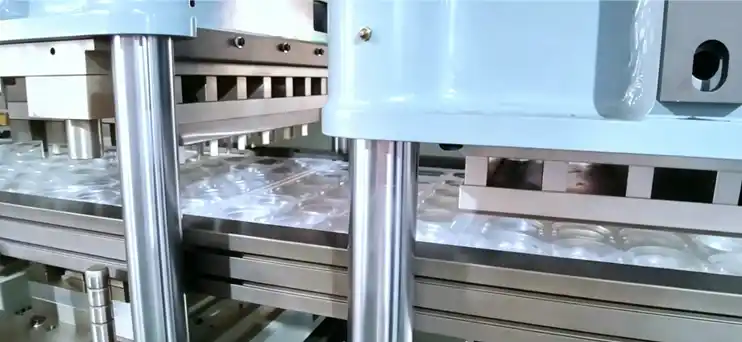
For a deeper look into how different stacking configurations impact production speeds for beverage containers, check out this technical overview.
Making the Final Call
Selecting the right machine is a balance between current capital and future operational expense. You want a platform that grows with you—one that supports mold changes without requiring a full engineering team.
The industry is moving toward "lights-out manufacturing" (unattended operation for night shifts). To achieve this, your equipment needs servo stability, zoned heating precision, and a jam-proof stacking unit.
If you are evaluating systems for high-volume beverage or food container production, you need a solution that addresses these five parameters specifically. The right system reduces regrind waste and ensures your cup rim is perfectly round, not oval.
If you are looking for a system designed with these engineering checks in mind, take a closer look at the Sayeah multi-station platform. It focuses on the modular separation of forming and cutting, servo-driven stacking accuracy, and user-friendly HMI controls. Click here to see how Sayeah’s solution applies to your specific cup dimensions.
Ultimately, the best machine is the one that disappears into your workflow. It doesn't demand attention; it just produces consistent parts, cycle after cycle. Don't just buy a press. Invest in a system that respects your material, your operators, and your uptime.